
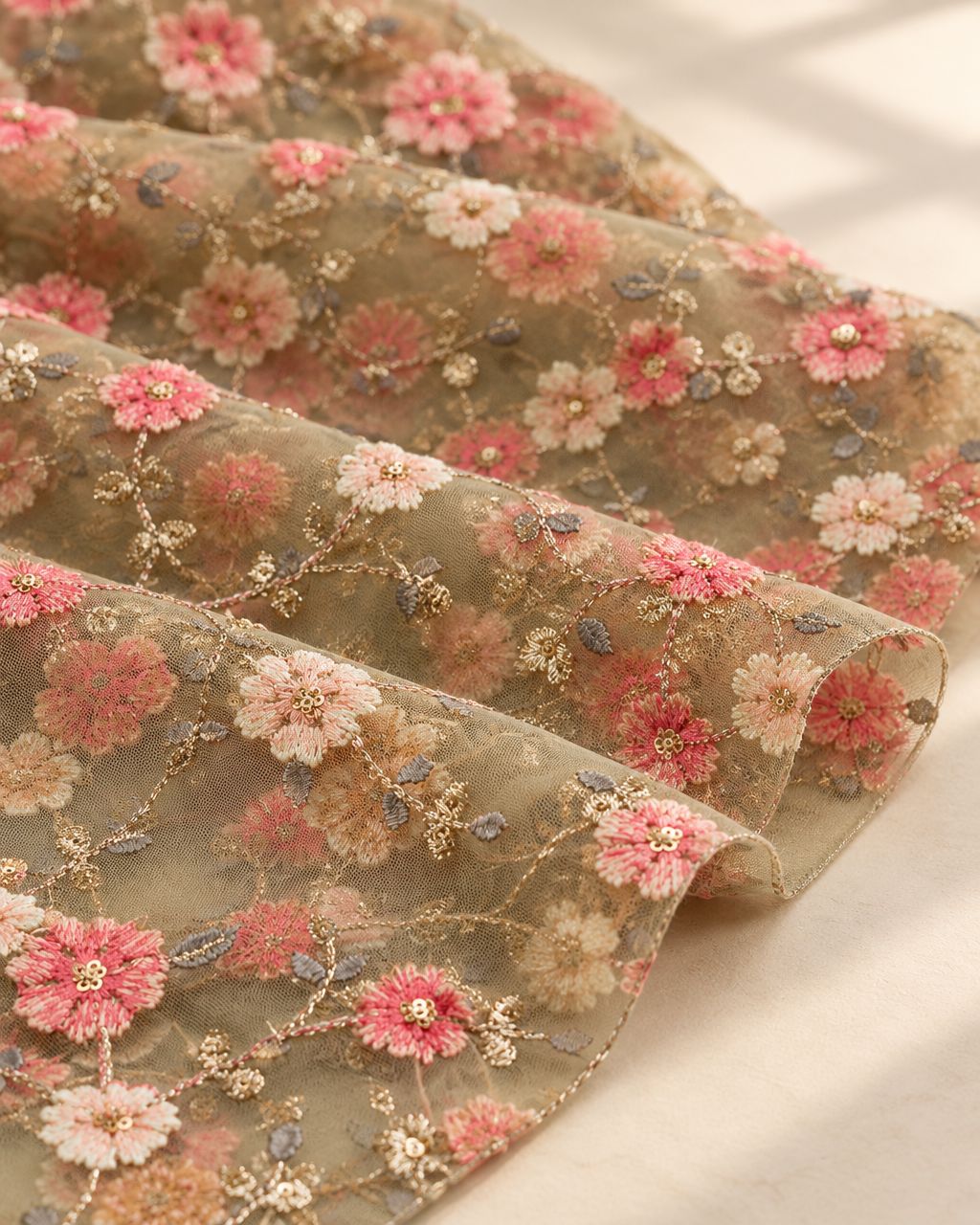
Choose embroidered fabric by matching its base, drape and embroidery placement to the outfit you want, then confirm lining and usable width before ordering. The prettiest close-up is only the beginning: the right fabric must also work where your tailor needs folds, seams and movement.
- Choose embroidered fabric for the garment, not just the motif in a photograph.
- Check net embroidery fabric with its intended lining before deciding on colour and transparency.
- Compare sequins fabric in close-up and full-width views before planning seams.
- Confirm usable width and motif placement with your tailor before ordering your cut.
Why the fabric choice matters before stitching
A floral trail can become the centre of a kurta, a quiet detail at a sleeve, or a border that frames a dupatta. Its placement changes the finished outfit. Embroidery is not simply decoration added to a neutral background; it is part of the design your tailor must work around.
Start with your intended garment when browsing an embroidered fabric collection. Decide whether you want flowing movement, a defined shape, or a sheer layer over another fabric. Then look for a design whose spacing and direction fit that purpose.
For an outfit you are planning in 2026, a useful buying brief is more valuable than a long list of trends. Write down the garment, occasion, lining needs and preferred amount of embellishment. Keep that brief beside your shortlist so every appealing photograph has to answer the same practical questions.
How do you choose embroidered fabric for your next outfit?
Follow this order: garment, base fabric, embroidery layout, lining, width and care. It keeps the decisions connected. Choosing quantity before checking the motif layout, for example, can leave your tailor unable to place a border where you imagined it.
| Design approach | Best for | What to inspect | Main limitation |
|---|---|---|---|
| Spaced embroidered motifs | Outfits where you want visible plain areas | Motif scale, repeat and position on each garment panel | Cutting without planning can leave motifs awkwardly placed |
| Dense all-over embroidery | A surface where decoration is the main feature | Drape, reverse side and seam placement | The finished result depends on the base and embroidery together |
| Border-led embroidery | Designs built around a decorated edge | Border direction and usable placement | A border cannot automatically serve every curved or angled pattern piece |
| Sheer embroidered overlay | Layered sleeves, skirts or dupattas | Transparency against the chosen underlayer | Colour and coverage change with the layer underneath |
These are design approaches, not promises about a particular fabric. An individual listing still needs to provide the information for your garment. A soft-looking photograph does not establish softness, composition or how the fabric will feel against your skin.
Start with the garment you actually want to stitch
Describe the shape before choosing its surface. A close-fitting blouse, a loose kurta and a wide skirt ask different things of the same embroidery. Your tailor should know whether the design needs a visible centre motif, uninterrupted borders, or plain areas around a neckline.
Bring a reference sketch or garment photograph to that conversation. Mark where the embroidery matters most instead of assuming it will fall into place after cutting. This is especially useful when the fabric has one obvious direction.
- Decide which garment areas should carry the strongest detail.
- Identify where folds, darts, closures and seams will sit.
- Choose whether the lining should blend in or contrast.
- Confirm which parts should remain sheer, if any.
Read the base fabric and the embroidery separately
A collection name describes only part of the choice. Check the individual product's stated base and composition, then consider how the decorative work covers it. Do not assume every fabric within a broad category has the same weight, transparency or care needs.
In your 2026 shortlist, keep a separate note for the base and the decoration. If a title and description appear to disagree, clarify that detail before ordering. Neither the sheen in a photograph nor an embroidered finish proves the fibre content.
When movement matters, ask for a view that shows the fabric hanging or folding rather than only lying flat. When structure matters, show your tailor the same evidence. A judgement based on an actual sample or a clear drape view is more useful than guessing from a tightly cropped motif.
Check the motif at garment scale
A close-up reveals stitches; it does not show what the design will look like across your body. Find a wider view that shows the repeat and the surrounding spaces. Compare the motif with the size of the garment panels your tailor intends to cut.
A large floral design is not automatically unsuitable for a small garment. The question is whether its important parts can fit where you want them. A motif cut through by a dart or closure can look very different from the unbroken design in a product photograph.
For a neckline, mark its proposed position before committing to the layout. For a skirt, check whether the design reads correctly across adjacent panels. For a dupatta, confirm whether the border arrangement suits the edges you want to display.
Choose the lining as part of the fabric decision
Lining is not an afterthought when you are buying sheer fabric. It affects visible colour, coverage and the way the surface embroidery reads. Compare the outer fabric against the intended lining, rather than judging it only against a white studio background.
If you are considering net embroidery fabric, decide whether the net is an overlay or a deliberately transparent part of the design. Those are different construction choices. Your tailor can identify where lining should stop and where a finished edge needs support.
- Check the lined appearance in both close-up and a wider view.
- Ask how the reverse of the embroidery will be handled at skin-contact areas.
- Confirm whether sleeves and the main garment need different coverage.
- Review the care requirements of the complete combination.
Doeraa offers embroidered fabrics for shoppers choosing their own outfits; the individual listing remains the reference for product details. A photograph can help you select a design, but it cannot settle every lining or tailoring question.
Confirm usable width before deciding on length
Fabric length only makes sense alongside width and the cutting plan. Ask for the usable width, not just the overall edge-to-edge measurement. Borders, unembroidered margins and the direction of the design can affect which part of the fabric your tailor can use.
The sizing guide displayed on Doeraa's site distinguishes fabric widths of 44 inches and 56–60 inches. That distinction matters, but those measurements do not tell you the width of every product. Check the actual listing and have your tailor calculate the cut for your measurements and silhouette.
Avoid treating a generic garment-length chart as a final cutting instruction. Matching motifs, arranging borders, adding flare and planning sleeves can all change a layout. The best question is not simply how many metres an outfit usually takes, but how the chosen fabric fits your specific pattern.
Check comfort and movement where they matter most
Think about how you will wear the garment, not just how it will look standing still. A celebration can mean sitting, walking, travelling and wearing the outfit for a long stretch. Discuss which decorated areas will touch your skin or rub against another part of the outfit.
For a fitted blouse, check the neckline and underarm plan. For a dupatta, think about the edge that rests near your neck. For a skirt, consider how the surface will sit against the blouse, bag or accessories you intend to carry.
Do not assume all sequins fabric feels alike. Ask about the actual material and construction, and let your tailor decide how embellished seam areas should be managed. Decorative appeal and comfortable finishing need to work together.
Read care instructions before approving the design
Ask how the completed outfit should be cleaned and stored. The answer must account for the base, embroidery, lining and any additional trims. Do not assume that an embroidered fabric can follow the same routine as a plain fabric with a similar name.
This is a practical choice for a 2026 occasion outfit you want to wear again. If the required care does not fit how you use your clothes, reconsider the design before it is cut. It is easier to choose a different fabric than to change the care needs of a finished garment.
For an outfit needed on a particular date, confirm current delivery information and leave room for your tailor's process. International shoppers should check shipping information for their destination. Doeraa ships globally, but a general shipping statement is not a delivery commitment for a specific order.
What makes one embroidered fabric more suitable than another?
Suitability comes from the whole combination, not a single label. Compare your shortlisted designs on the same practical criteria:
- Garment shape: check whether the fabric supports the movement or definition you want.
- Embroidery coverage: decide how much of the base you want to remain visible.
- Motif direction: establish whether pattern pieces must face the same way.
- Lining plan: judge the visible result with the intended underlayer.
- Usable area: confirm the width and any layout constraints before calculating length.
- Care: choose a finished outfit you can realistically look after.
The best embroidered fabric is the one whose layout and handling suit your garment, not the one with the most decoration. A restrained design can be the stronger choice when the cut is already detailed. Conversely, an uncomplicated garment can give an expressive surface room to be seen.
How should you compare embroidered fabric photographs online?
Use different photographs for different questions. A detail shot helps you examine motif edges and decorative elements; a wider shot helps you judge spacing. A draped view is useful for movement, while a reverse-side view can help you discuss finishing with your tailor.
Screens and lighting affect colour appearance. Compare images within a listing, read the colour description, and ask for clarification when an exact match matters. Avoid promising yourself that two independently photographed fabrics will match merely because they look similar on your phone.
For your final 2026 comparison, record what is confirmed and what remains unanswered. Do not turn an unanswered question into an assumption. This keeps a visually exciting choice from becoming an avoidable tailoring problem.
FAQ
What should I check first when buying embroidered fabric?
Check the garment you want to make first, then compare the fabric's base, motif placement, lining needs and usable width. Those details determine whether the design fits your cutting plan.
Is net embroidery fabric suitable for a lined outfit?
Net embroidery fabric can be used as a layer over lining when the fabric and garment construction suit the design. Decide on coverage and check the appearance against the intended lining before ordering.
Can I choose embroidered fabric from a close-up photograph alone?
A close-up photograph is not enough to judge the full layout. Look for wider views showing motif spacing and borders, and seek clarification about composition, width and drape.
How many metres of embroidered fabric should I buy?
The required length depends on your measurements, garment shape, usable fabric width and embroidery layout. Ask your tailor to calculate the cutting plan for the specific fabric rather than relying on a generic estimate.
Does dense embroidery always mean better fabric?
Dense embroidery does not by itself establish fabric quality or suitability. Compare the actual base, stitching details, finishing and garment requirements instead of judging by coverage alone.
Should I buy lining before or after embroidered fabric?
Plan lining alongside embroidered fabric, particularly for sheer designs. The underlayer changes visible colour and coverage, so compare them together before committing to the finished look.
Can boutiques use the same checks for wholesale fabric?
Boutiques should use the same garment, width and layout checks, then confirm the details needed for their specific order. For repeat designs, clarify colour consistency, quantities and current ordering terms before committing.
One last thing: place the motif before you place the order
Before finalising your 2026 outfit, send your tailor the full-width fabric image with the desired neckline, hem or centre panel marked. Ask one direct question: can the important embroidery sit where this garment needs it?
That conversation protects the detail that drew you to the fabric in the first place. Choose the cloth for the finished outfit, not the photograph alone. Doeraa's embroidered fabric range is a starting point for that choice; your confirmed product details and cutting plan turn it into a wearable design.



Leave a comment
This site is protected by hCaptcha and the hCaptcha Privacy Policy and Terms of Service apply.