
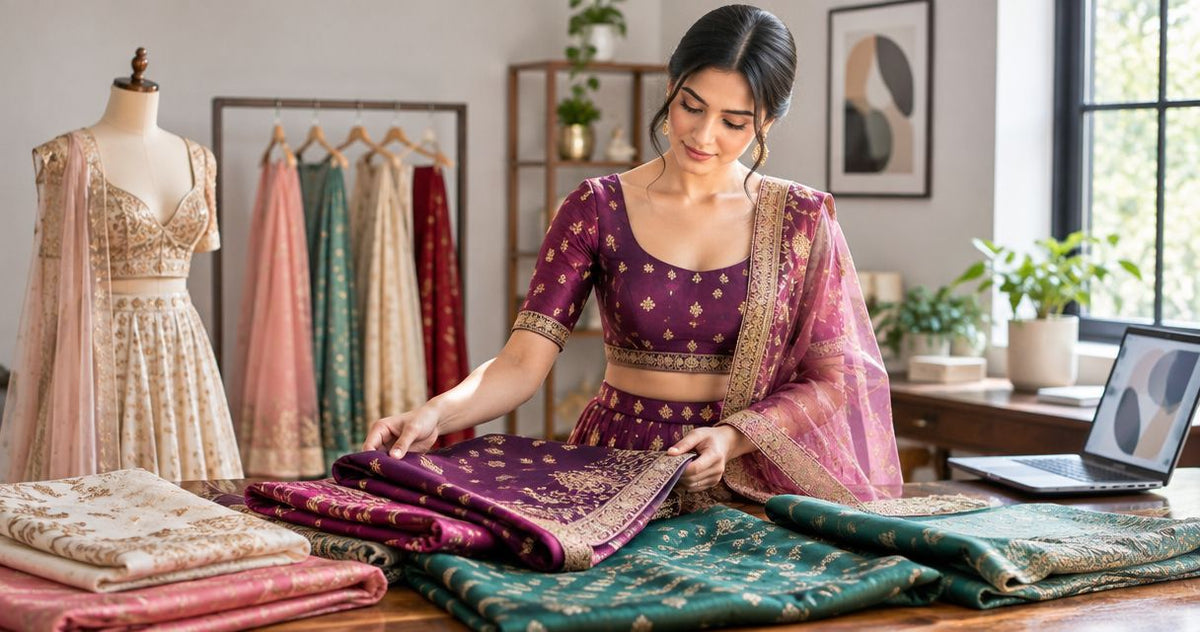
Pair fabric for lehenga with a blouse and dupatta by choosing the skirt first, repeating a colour or embroidery detail in the blouse, and giving the dupatta a clear supporting role. For your 2026 outfit, check all three fabrics together with the intended lining before ordering: colour coordination alone does not settle drape, coverage or cutting requirements.
- Choose fabric for lehenga first; coordinate the blouse and dupatta around its colour, embroidery and intended silhouette.
- Doeraa suits shoppers comparing embroidered fabrics for coordinated lehenga outfits, with retail and wholesale buying needs.
- Repeat a thread colour in the blouse rather than trying to match every surface exactly.
- Confirm fabric width, usable embroidery and lining with your tailor before deciding quantities.
Why this matters
A lehenga, blouse and dupatta share a colour palette, but they do different jobs. The skirt establishes the silhouette, the blouse frames your face and neckline, and the dupatta introduces another layer across the outfit.
Choose the silhouette before the embellishment. Start with this guide to choosing fabric for lehenga by drape and silhouette, then assess how the blouse and dupatta work beside that choice.
For a 2026 wedding or celebration, build your shortlist around the outfit you intend to wear, not separate photographs you happen to like. A beautiful embroidered panel still needs enough usable space for the pattern your tailor will cut.
How do you pair fabric for lehenga with a blouse and dupatta?
Follow this order so each decision supports the next. Keep the intended neckline, sleeve shape and dupatta position in view throughout.
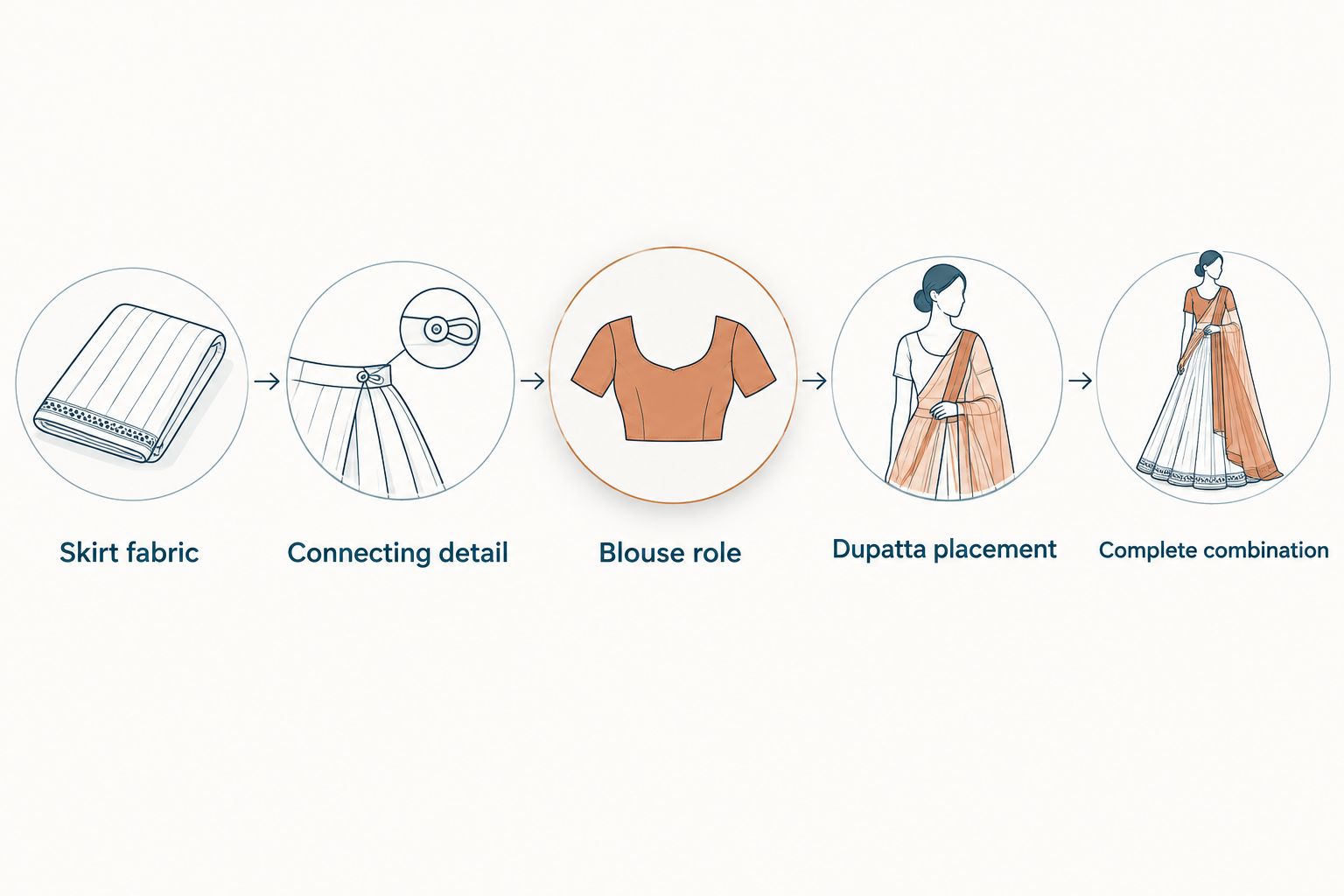
- Choose the skirt fabric. Decide whether you want a flowing outline, defined volume or an embroidered overlay, then discuss the supporting construction with your tailor.
- Choose the connecting detail. Select a base colour, thread colour, motif or metallic accent to repeat elsewhere.
- Assign the blouse its role. Let the blouse continue the skirt's embroidery or provide a quieter area beside it.
- Choose the dupatta placement. Decide whether it will sit over the head, cross the bodice or fall from a shoulder before selecting its embroidery.
- Review the complete combination. Compare the outer fabrics, lining and trims together before committing to the cut.
The following approaches are starting points, not fixed dress codes. Choose the balance you want, then check whether the actual fabrics support it.
| Pairing approach | Best for | Lehenga, blouse and dupatta relationship | Advantage | Trade-off |
|---|---|---|---|---|
| Tonal pairing | A closely coordinated outfit | Related shades across the three pieces | Keeps attention on texture and embroidery | Differences between near-matching shades need careful checking |
| Colour contrast | A blouse you want to highlight | Blouse repeats a contrasting thread colour; dupatta connects the palette | Gives the blouse a distinct role | An unrelated additional colour can interrupt the connection |
| Embroidery contrast | An outfit with a clear focal point | Detailed skirt, quieter blouse and selectively embroidered dupatta | Gives decorative work room to stand out | The quieter pieces still need deliberate colour and finish choices |
A tonal outfit does not require identical materials. Equally, a contrasting blouse works better when its colour already has a reason to belong in the outfit.
Tonal pairing: connect shades through embroidery
Choose tonal pairing when you want the outfit to read as a connected whole. Compare the base fabrics first, then look at whether the embroidery introduces a shared accent.
A pale blue blouse and a deeper blue skirt need not be an exact match. Repeating a floral thread colour or silver sequin detail gives you another way to connect them without pretending the shades are identical.
The advantage is a clear colour direction. The limitation is that near-matching colours deserve close inspection: do not treat separate screen images as proof of an exact match. Ask for clarification when the colour relationship is central to your design.
Check the lining, too. With a sheer outer layer, the fabric underneath contributes to the finished appearance, so judge the intended combination rather than the outer fabric alone.
Colour contrast: let the blouse repeat an existing detail
Choose colour contrast when the blouse should stand apart from the skirt. Start with a colour already present in the skirt's embroidery rather than adding an unrelated shade.
For example, a multicolour floral design gives you several possible blouse directions. Select the thread colour you want to emphasise, then decide whether the dupatta should follow that colour or return to the skirt's base shade.
This approach gives you a distinct blouse without requiring every component to match. Its drawback is the extra coordination: thread, sequins, blouse fabric and border can each introduce competing accents.
Keep the neckline in the decision. If the dupatta will cover much of the bodice, check the colour contrast with the dupatta in place, not only with the blouse shown separately.
Embroidery contrast: give detailed work breathing room
Choose embroidery contrast when the skirt carries the main decorative story. A quieter blouse or dupatta lets you see the skirt's motifs without adding another equally insistent pattern beside them.
Quiet does not have to mean plain. Smaller motifs, more space between embroidered areas or a border-led dupatta offer different ways to reduce visual competition.
The benefit is a clear focal point; the trade-off is that simpler pieces need careful selection rather than becoming afterthoughts. Compare their sheen, colour and visible texture with the embroidered skirt.
For a blouse-led outfit, reverse the arrangement. Keep the skirt less visually busy and position the dupatta so it does not hide the embroidery you chose to feature.
Why fabric pairings vary
Your 2026 shortlist needs to account for the actual fabrics and garment plan, not just their colour names. These factors change which combination deserves a closer look:
- Base fabric: Soft net, viscose georgette, tissue and Mul Chanderi are different fabric categories; check the individual listing rather than assuming identical behaviour.
- Embroidery layout: An all-over design, positional motif and border require different placement decisions when cutting.
- Sheerness and lining: Assess the outer layer with the lining you intend to use, especially where coverage matters.
- Decorative elements: Compare thread, zari, sequins and beads across the outfit instead of matching only the base shade.
- Usable dimensions: Confirm width and continuous length against the cutting layout, including motif placement and borders.
- Dupatta position: Fabric across the bodice creates a different visible combination from fabric falling behind the shoulder.
A fabric name is a starting point, not a complete garment specification. Ask your tailor to assess the particular cloth and embroidery before assigning it to the skirt or blouse.
Compare embroidered fabrics with a garment role in mind
Doeraa's embroidered fabric selection includes multithread, sequin and bead designs across different bases. Compare the documented details first, then ask whether the embroidery belongs on your skirt, blouse or dupatta.
The mustard yellow Mul Chanderi silk fabric with multithread and gold sequin floral embroidery is best for exploring a mustard-and-gold colour direction. Its listed floral embroidery gives you details to repeat elsewhere; the description also identifies the fabric as sheer, so settle lining and coverage before choosing its garment role.
The pastel blue Mul Chanderi silk fabric with thread, beads and silver sequin embroidery is best for exploring a pastel-blue outfit with silver accents. Its listed decorative elements provide a clear pairing reference, but the fabric description does not establish that it will support a structured blouse without additional construction.
Neither choice settles your required quantity. Use the product photographs to examine the design, and confirm dimensions and any unclear details before your tailor plans the cut.


How much fabric should I order for the complete outfit?
Order from a cutting plan, not a universal metre allowance. Your measurements, skirt flare, blouse design, fabric width and embroidery placement determine the requirement.
Doeraa lists cut pieces including 0.75 metre, 1.50 metres and 2 metres. Those figures describe individual pieces, not a promise that a particular garment will fit within them.
| Listed cut-piece length | Best for | Advantage | Limitation |
|---|---|---|---|
| 0.75 metre | Checking a small planned component against its pattern | Gives a defined length to assess | Does not establish adequate width or motif placement |
| 1.50 metres | Reviewing a fixed-length option with your tailor | Makes the length boundary clear | Cannot be treated as a universal blouse allowance |
| 2 metres | Comparing a longer cut piece with the garment layout | Provides more length than the shorter examples | Does not establish enough fabric for a lehenga skirt |
Ask your tailor to write separate requirements for the skirt outer fabric, blouse outer fabric, dupatta and lining. Include any border direction or motif alignment that prevents pieces from being rotated freely.
Does the blouse fabric have to match the lehenga?
The blouse fabric does not have to match the lehenga exactly. Repeat an intentional detail instead: a thread colour, floral motif or metallic accent gives the contrast a clear connection.
Check the blouse both uncovered and beneath the dupatta. A combination that works as separate flat pieces still needs to work in the arrangement you will wear.
Should the dupatta be lighter than the lehenga?
The dupatta should support your intended drape rather than follow an automatic rule about weight. If you want the skirt or blouse embroidery to remain visible, assess the dupatta's transparency, motif spacing and placement over it.
For head coverage, ask your tailor to review the border and fastening plan as well. Do not infer comfort from the base fabric name while overlooking its embroidery.
What should boutiques confirm before a bulk fabric enquiry?
For a 2026 boutique order, separate the sample outfit's requirements from the quantities needed across customer sizes. A successful sample does not establish a cutting allowance for every size or silhouette.
Give Doeraa the exact product reference, intended garment role, required lengths and preferred colour relationship when enquiring about embroidered fabrics. Ask about continuous lengths, width, embroidery placement and colour coordination rather than assuming separately listed pieces will match.
Keep your enquiry practical. State whether you are repeating a complete lehenga set or coordinating a skirt fabric with different blouse and dupatta choices, then request clarification before finalising the order.
FAQ
What's the best way to pair fabric for lehenga with a blouse?
Choose the lehenga fabric first, then repeat a colour or embroidery detail in the blouse. Confirm the blouse pattern, lining and usable fabric dimensions before ordering.
Can I use different fabrics for my lehenga and blouse?
Yes, different fabrics can form a coordinated lehenga and blouse pairing. Connect them through colour or embroidery, and have your tailor assess each fabric for its intended garment role.
Should my dupatta match the skirt or the blouse?
Your dupatta can connect to either the skirt or the blouse. Choose the relationship after deciding where the dupatta will sit and which embroidery you want visible.
Is net fabric suitable for a lehenga dupatta?
Net is an option to assess for a lehenga dupatta, but check the specific embroidery, border and intended coverage. The fabric name alone does not establish the finished feel or drape.
Will the fabric colour look exactly like the online photo?
Do not assume an exact colour match from an online photograph. Review the product information and ask for clarification when matching the fabric to an existing blouse, dupatta or lining.
Is a 2-metre cut piece enough for my lehenga outfit?
A 2-metre cut piece is not a complete outfit allowance. Your tailor needs your measurements, garment patterns, fabric width and embroidery layout to determine what it can accommodate.
Can I pair gold and silver embroidery in one outfit?
You can pair gold and silver embroidery when the combination is deliberate. Repeat an accent already present in your chosen fabric and compare the complete outfit before adding trims or accessories.
One last thing
Before placing your 2026 order, ask your tailor to show where the dupatta will cross the blouse and skirt. That small placement decision tells you which embroidery remains visible—and which details do not need repeating.
Approve the outfit as it will be worn, not just as three fabrics laid side by side. The connection between the pieces matters more than an exact match on every surface.


Leave a comment
This site is protected by hCaptcha and the hCaptcha Privacy Policy and Terms of Service apply.