
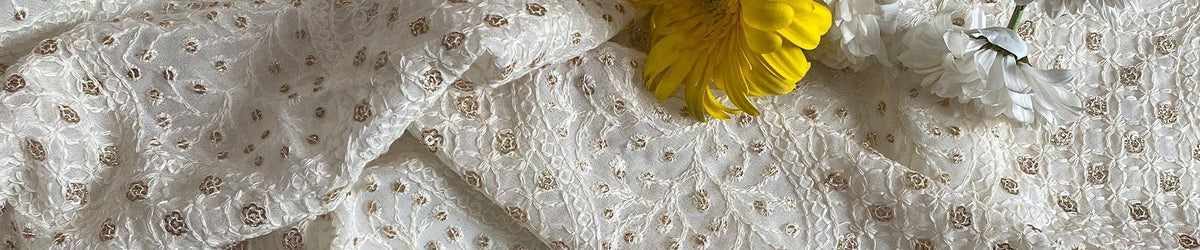
Choose fabric for lehenga by deciding how you want the skirt to fall, then checking whether the fabric, embroidery and lining support that shape. Confirm the cutting plan before ordering: a flowing skirt and a defined, panelled silhouette do not ask the same things of the cloth.
- Choose fabric for lehenga by the finished silhouette, not embroidery alone.
- Compare the outer fabric with its intended lining before judging movement.
- Doeraa suits shoppers comparing embroidered fabrics for a personally tailored outfit.
- Confirm usable width and motif direction before your tailor calculates length.
Why the silhouette comes first
A lehenga is a relationship between cloth and construction. The same attractive surface can look different when gathered, divided into panels or supported underneath. Decide what you want the skirt to do before asking which fabric name is best.
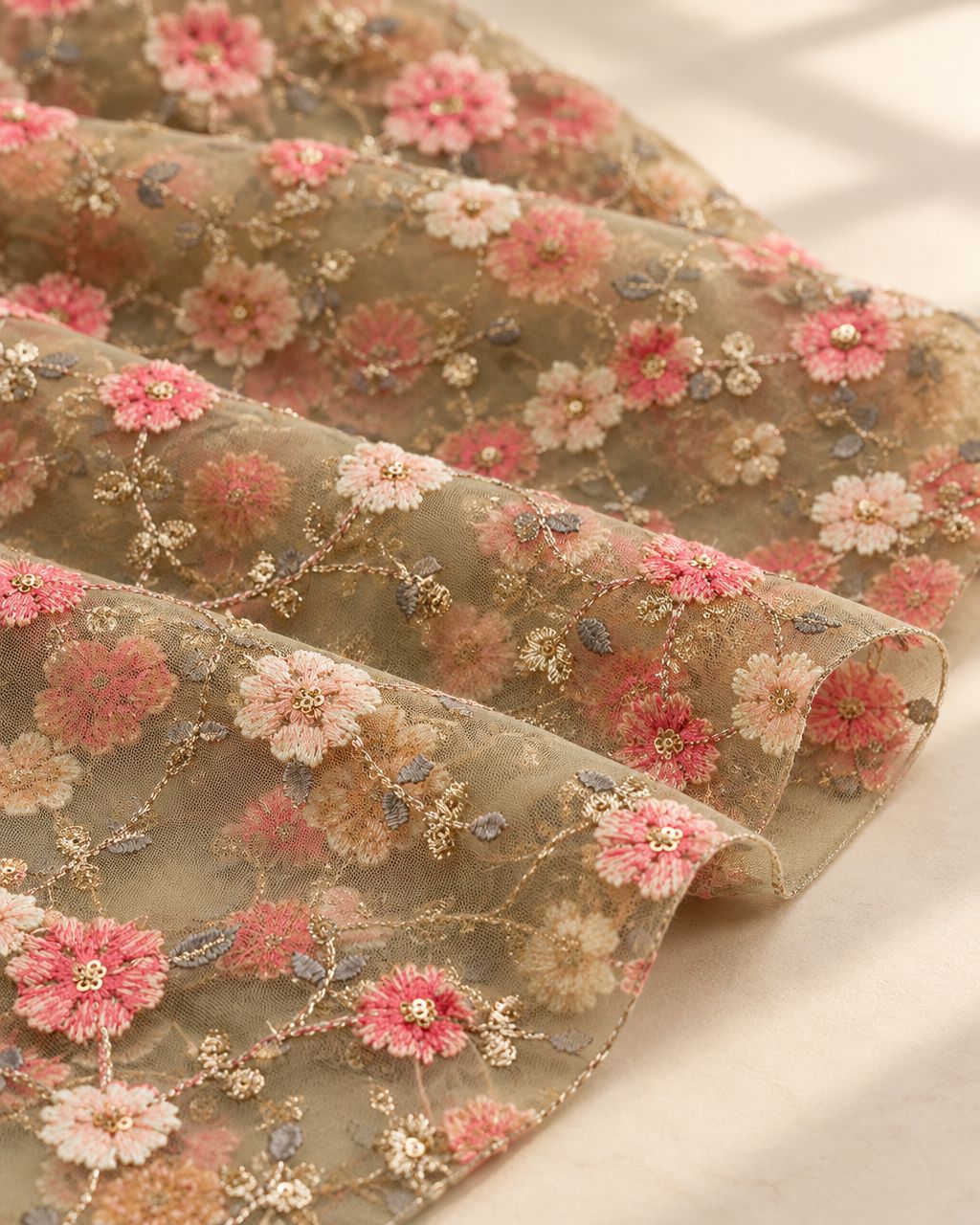
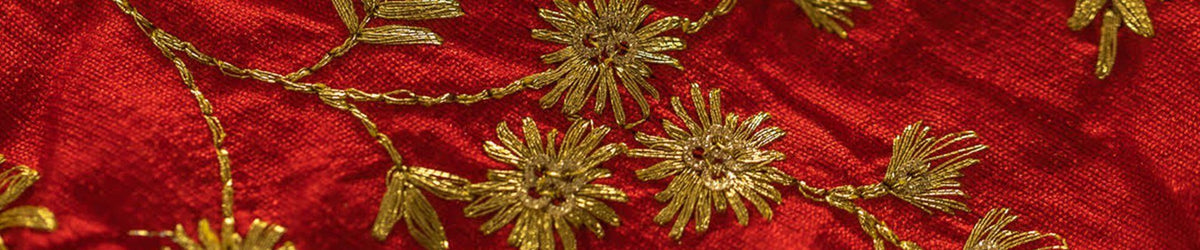
If you are starting with Doeraa's embroidery fabrics, compare a full view with the close-up. Detail photographs show stitches, but they cannot show the finished skirt's movement. Ask for clarification when the available pictures do not answer your design question.
For a 2026 wedding outfit, begin with a short brief: desired shape, occasion, embroidery coverage and comfort priorities. Show the brief to your tailor. It gives both of you a reason to choose or reject a fabric beyond colour alone.
How do you choose fabric for lehenga by drape and silhouette?
Use this sequence before deciding on quantity:
- Choose the outline you want at the waist and hem.
- Identify the cutting method with your tailor.
- Compare the fabric's movement with the proposed lining.
- Place the strongest embroidery on the garment sketch.
- Confirm usable width and the pattern layout.
- Check care needs for the complete outfit.
| Silhouette approach | Best for | What to inspect | Main limitation |
|---|---|---|---|
| Flowing skirt | Movement and softer folds | Hanging view and response to folding | A flat photograph cannot establish movement |
| Defined skirt | A clearer outline | Outer fabric with planned support | Structure depends on construction, not the fabric name alone |
| Panelled skirt | Controlled placement across sections | Repeat, direction and panel joins | Motif matching complicates the cutting layout |
| Sheer overlay | Layered colour and embroidery | Outer fabric over the chosen lining | Every underlayer changes the visible result |
These are construction choices rather than fixed fabric categories. A particular material must be assessed on its own details. Avoid assuming that every item called silk, net or georgette will behave identically.
Describe the finished outline
Choose a reference that shows the skirt from the side as well as the front. Decide whether you want the fabric to fall close to the body, spread into a broad outline or move freely around the legs. A single posed photograph can hide how much support sits underneath.
Tell your tailor which part of the reference you actually like. You might love the embroidery placement but prefer a less defined shape. Separating those preferences prevents a fabric choice that solves the wrong problem.
For your 2026 shortlist, record the outline in plain language. Terms such as flowing, defined and layered are useful starting points, but the sketch should settle what they mean. The tailor's pattern is the final reference for construction.
Judge movement instead of assuming it
Look for the fabric hanging, falling over an edge or forming a loose fold. Those views give more information than a close-up stretched flat. They still do not replace handling a sample when the movement is central to your design.
Embroidery changes how the surface behaves. Inspect decorated and less decorated areas together. A fabric that folds softly between motifs does not necessarily fold the same way through a densely worked border.
Do not turn the title of a collection into a guarantee about weight or stiffness. Check the individual product description, and clarify conflicting details. Doeraa's embroidered fabrics span different designs; suitability belongs to the item and the intended garment.
Plan the lining alongside the outer fabric
Compare the outer layer with the lining you intend to use. Lining affects coverage, colour and the finished feel of the skirt. Where a sheer outer fabric is involved, the underlayer becomes part of the visible design.
A pale lining can make spaces around embroidery more noticeable. A closer colour match gives a different result. Neither approach is automatically better; choose the one that supports the outfit you sketched.
Discuss the whole combination with your tailor:
- Which layers provide coverage?
- Which layers provide the intended outline?
- Where will the layers be joined?
- How will the waistband carry the finished garment?
- How will the combined materials be cleaned?
Avoid approving an outer fabric first and treating every construction decision as something to solve later. A design can be beautiful yet unsuitable for the amount of support or care you want.
Place the embroidery before calculating length
Identify the strongest visual element. It might be a border, a large flower or a repeating trail. Mark where that detail should sit on the skirt, especially at the centre front, panel joins and hem.
A wide border that looks impressive across a roll does not automatically follow every curved hem. Ask your tailor how the border will be used. The answer should come before the final quantity calculation, not after the cut arrives.
If a motif has an obvious top and bottom, confirm that every relevant pattern piece can face the right way. Turning pieces to fit a smaller cut can change the appearance. Your layout must account for direction rather than relying on area alone.
Separate the skirt from the complete outfit
Choose how much visual attention the lehenga should carry compared with the blouse and dupatta. Dense decoration on every part is a design decision, not a requirement. You can give the skirt the main role and keep another component quieter.
Place the proposed fabrics next to each other before stitching. Compare the scale of the motifs, the amount of shine and the colour relationships. Several beautiful fabrics do not automatically form a balanced outfit.
For a 2026 celebration, think about wearing the outfit beyond the first event. A skirt that pairs with more than one blouse offers different styling choices. That is a preference to build into the brief, not a promise about a particular product.
Which fabric approach suits a flowing lehenga?
For a flowing lehenga, prioritise evidence of movement in the actual material. Ask your tailor to assess the outer fabric and lining together. A fabric's name is less useful than a clear hanging view or a sample.
An embroidery layout with open spaces gives you different cutting choices from a dense border-led surface. Compare those choices on the sketch. The key question is whether the decorated areas fall naturally where the skirt needs to fold.
When browsing embroidered georgette fabrics, use the individual listing rather than assuming a common result across the collection. Confirm composition, width and care before approving a design. A category can narrow your search without making the final decision for you.
Which fabric approach suits a defined lehenga?
For a defined lehenga, assess the intended outline with your tailor before deciding on support. The finished shape depends on the complete construction. Buying a fabric described as structured does not settle the waistband, lining or hem.
Raw silk fabrics are one collection to discuss when exploring a more defined design, but the listing must establish the actual material. Do not infer fibre content or stiffness from sheen alone. Ask how the selected fabric will behave in the proposed cut.
The main trade-off is the relationship between appearance and wear. A skirt that holds a pronounced outline also needs to work when you sit, walk and travel. Review those movements before the design is finalised.
Why does the result vary between lehengas?
The finished result varies because several decisions work together:
- Fabric behaviour: how the selected cloth bends and falls.
- Embroidery coverage: where decorative work changes the surface.
- Pattern shape: how panels and seams distribute the cloth.
- Lining choice: how coverage and movement are supported.
- Border placement: whether the design fits the planned hem.
- Finishing: how the waist, seams and edges are constructed.
This is why a generic metre estimate is not a complete buying instruction. Two skirts with similar finished measurements can use the available width differently. Confirm the layout for your garment, not a broadly similar reference.
How should you check the fabric before ordering online?
Save the product details with the reference sketch and note every unanswered question. Check colour description, composition, usable width, embroidery direction and care. When the listing is unclear, ask before making a commitment.
Use the same checklist for every shortlisted option. It is easier to compare two designs when you have comparable information. Do not reward one listing merely because it has a more dramatic photograph.
Doeraa offers embroidered fabrics for shoppers planning their own outfits, alongside boutique and wholesale buyers. The practical benefit is being able to compare designs within that buying context. The limitation is that online photographs cannot establish how a completed custom garment will fit or feel.
FAQ
What should I choose first for a lehenga, fabric or silhouette?
Choose the silhouette first, then assess fabric against that shape. Your tailor should confirm the cutting method and lining before calculating quantity.
Is a heavy-looking fabric always better for a defined lehenga?
A heavy-looking fabric is not automatically better for a defined lehenga. The actual fabric, embroidery and internal construction must support the outline together.
Can net embroidery fabric be used for a lehenga?
Net embroidery fabric can form a sheer outer layer when the lining and construction suit the garment. Check coverage, border placement and the appearance over the intended underlayer.
How much fabric do I need for a lehenga?
The required length depends on usable width, measurements, flare and embroidery layout. Have your tailor calculate the specific cutting plan rather than relying on a generic number.
Should the blouse and lehenga have matching embroidery?
Matching embroidery is optional. Compare motif scale, colour and shine across the outfit, then choose which component should attract the most attention.
Can I judge drape from a product close-up?
A close-up does not establish drape. Look for hanging or folded views, and seek a sample or further clarification when movement is important to your design.
One last thing: test the seated outfit
Before approving your 2026 lehenga design, ask how the planned skirt will behave when you sit. Review the waistband, the folds across your lap and the placement of decorated areas. This question often makes the brief more useful than another photograph of the hem.
Choose fabric for the silhouette you want to wear, not merely the silhouette you want to photograph. Use Doeraa's product information to narrow your choices, then let the confirmed cutting plan settle the order.


Leave a comment
This site is protected by hCaptcha and the hCaptcha Privacy Policy and Terms of Service apply.