
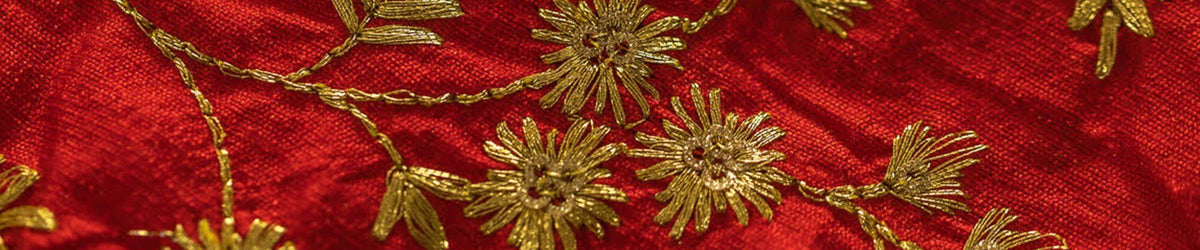
Choose raw silk fabric for a structured blouse by checking the actual composition, firmness and embroidery layout against your tailor's pattern. Plan the lining and neckline at the same time: the fabric name alone does not guarantee the shape or support your blouse needs.
- Choose raw silk fabric using the individual listing, not sheen or texture alone.
- Mark neckline, darts and closures before committing to embroidered placement.
- Doeraa suits shoppers comparing raw silk fabric designs for custom blouses.
- Calculate length from the pattern and usable width, including sleeves and motif direction.
Why a blouse needs a different buying checklist
A blouse puts fabric close to the body and brings seams, shaping and fastenings into a small area. A motif that looks balanced on the roll can land awkwardly beside a neckline or dart. Fabric selection and pattern planning belong in the same conversation.
Start with the actual raw silk collection, then record the details of each shortlisted listing. A collection label does not establish that every item has identical composition or handling. Clarify anything that is missing before deciding that a fabric will create structure.
For a 2026 occasion blouse, write down what structured means to you. It might mean a defined neckline, a smooth front or sleeves that keep their intended outline. Those are different needs, and your tailor should know which one matters most.
How do you choose raw silk fabric for a structured blouse?
Work from the blouse pattern outward rather than from the surface inward:
- Finalise the neckline, back shape and sleeve design.
- Check the fabric's stated composition and usable width.
- Review a folded or hanging view with your tailor.
- Place motifs around darts, seams and closures.
- Select lining and any construction support.
- Confirm quantity, care and the fitting process.
| Fabric approach | Best for | Advantage | Limitation to review |
|---|---|---|---|
| Plain surface | A blouse where the cut is the main detail | Uninterrupted space for shaping | Surface and seam finish remain visible |
| Spaced embroidery | Selected decorative placement | More freedom around some pattern areas | Motifs still need planning at darts and edges |
| Dense embroidery | A decoration-led blouse | Strong visual emphasis | Seam finishing needs assessment |
| Border-led design | A planned sleeve or hem detail | Clear edge placement | Not every border follows a curved neckline |
These options describe layout, not quality grades. Denser decoration is not proof of a better fabric. The right choice is the one whose base and design work with the finished blouse.
Confirm what the listing actually says
Read the composition separately from the title. Raw silk is used in shopping language across different products, so ask for the fibre information that applies to your exact choice. A textured appearance or visible sheen is not a substitute for that detail.
Check width, colour description, embroidery materials and care information. Keep the answers with the product reference. If you later compare another option, use the same fields rather than relying on memory.
Doeraa carries embroidered and dyed fabrics for individual shoppers and trade buyers. That gives you a relevant starting point, but it does not make every raw silk fabric interchangeable. The product details must still support the blouse you want to stitch.
Decide where structure is needed
Show your tailor the finished outline rather than simply asking for a stiff fabric. The neckline, front, back and sleeves can require different construction choices. An outfit reference should make those priorities visible.
Ask how the fabric will work with the proposed lining and support. A stronger outline is a result of the complete garment. Trying to obtain it only through the outer fabric can lead to a choice that does not match the construction plan.
For your 2026 brief, separate appearance from comfort:
- Which edges should keep a defined shape?
- Which areas should follow the body?
- How much movement do the sleeves need?
- Where will fastenings and seam allowances sit?
- Which decorated areas could touch skin?
A clear answer to each question helps the tailor judge the actual cloth. It also avoids unnecessary decoration in a place where the design needs a clean finish.
Mark the neckline before selecting a motif
Place the proposed neckline on a full view of the fabric. Check whether the important part of the embroidery remains inside the finished garment, rather than disappearing into the cut-out or seam allowance. Consider the back neckline separately.
A border along a straight fabric edge does not automatically form a curved neckline. Your tailor should decide whether it can be used as intended. Confirm that construction before ordering around an imagined placement.
If the blouse has a centre opening, review both sides together. The design should still make sense when the closure is finished. A motif that works on one uninterrupted panel can require a different layout around a fastening.
Put darts and seams on the same sketch
Darts shape the garment and can interrupt an embroidered motif. Mark them on the design reference before cutting. Decide whether you are comfortable with a motif crossing that area or whether you want plainer space around the shaping.
Check shoulder and side seams as well. A large motif near an edge might be partly hidden when the garment is assembled. This is not necessarily a fault, but it should be an intentional outcome rather than a surprise.
For a decorated sleeve, decide which part will be most visible when your arms are at rest. Placing the strongest detail only for a flat photograph can miss how the sleeve will look when worn. Ask the tailor to show the proposed orientation.
Select lining for the complete blouse
Choose lining with the outer material in front of you. Discuss comfort, coverage and the way the combination handles shaping. The lining needs to suit the blouse pattern as well as the fabric.
Do not infer care compatibility because two fabrics have similar colour or texture. Check how the completed blouse should be cleaned. Any added support or trims must be considered alongside the outer fabric and lining.
For a 2026 wedding blouse, think beyond the first fitting. You will sit, reach, travel and wear the garment for more than a moment. Tell your tailor how the blouse will be used so finishing decisions reflect real wear.
Check colour with the garment it will accompany
Place the blouse fabric beside the saree, lehenga or dupatta it will accompany. An apparent match on separate screens is not a confirmed match. Lighting and surrounding colours change what you see.
Decide whether you want a close match, a related shade or a deliberate contrast. Each is a valid design direction. The mistake is allowing an uncertain match to make that choice for you.
Compare the embroidery thread or decorative shine as well as the base colour. A small metallic element can affect how the full outfit reads. Judge the complete combination rather than matching one isolated patch.
Calculate the order from a real pattern
Give the tailor the usable width before asking for a fabric-length recommendation. Blouse length depends on the size, sleeves, neckline, pattern and embroidery direction. A generic blouse estimate is not enough to settle every custom cut.
The sizing guide on Doeraa's site distinguishes 44-inch fabric from 56–60-inch fabric. Use that as a reminder to check width, not as proof of the width of your selected product. The actual listing is the reference.
Have the tailor account for every component:
- Front and back pattern pieces.
- Sleeves and any cuffs.
- Facings or other outer-fabric details.
- Directional motifs and matching needs.
- Areas that cannot be used for the planned cut.
This protects the intended design without inventing a universal allowance. The amount should follow a layout that works for your measurements.
Is plain or embroidered raw silk better for a blouse?
Plain raw silk fabric is a useful approach when the cut is the main feature; embroidered raw silk fabric suits a design where placement is central. Neither wins universally. Assess the actual base, care needs and pattern before choosing.
A plain surface gives you fewer motif-placement decisions but leaves shaping and finishing more visible. Embroidery contributes its own visual structure, yet requires more planning around darts, openings and edges. Choose the trade-off that fits your blouse.
If you are still deciding how much decoration you want, compare the wider embroidery fabric range. Use the comparison to clarify your design brief rather than assuming the most elaborate surface is automatically the right one.
Why does one raw silk blouse feel different from another?
The result varies because fabric and construction interact:
- Composition: the fibre information in the actual listing.
- Fabric handling: how the selected material folds and responds to shaping.
- Embroidery: its location, coverage and reverse-side finish.
- Lining: the layer worn inside the outer fabric.
- Pattern: the neckline, sleeve and shaping decisions.
- Finishing: how seams, edges and closures are completed.
Do not attribute the whole result to the raw silk label. If you are comparing a sample blouse with a new fabric, ask which of these details differ. That gives your tailor a useful problem to solve.
What should you check at the fitting?
Check the neckline, shoulder position and sleeve movement before focusing only on appearance. Sit down, reach naturally and review how the front and back settle. Tell your tailor where you feel restriction or rubbing.
Look at embroidery placement in the worn garment rather than only on the hanger. The body changes how motifs are seen. A fitting is the moment to compare the result with the design decisions you recorded before cutting.
For a 2026 blouse you intend to pair with several outfits, test it with the most important pairing. Confirm that the neckline and visible decoration work with the drape of that outfit. Doeraa supplies the fabric choices; your fitting confirms the custom garment.
FAQ
Does raw silk fabric always make a structured blouse?
Raw silk fabric does not automatically create a structured blouse. The individual material, lining, pattern and construction must work together to produce the intended shape.
How much raw silk fabric should I buy for a blouse?
The required length depends on your measurements, sleeve design, usable width and embroidery layout. Ask your tailor to calculate the actual pattern placement before ordering.
Can I use a border around a blouse neckline?
A fabric border needs a construction plan before it is used around a neckline. A straight border does not automatically follow a curved opening, so confirm the approach with your tailor.
Should an embroidered blouse have lining?
Decide lining with your tailor using the actual outer fabric and garment design. Discuss coverage, comfort, shaping and compatible care rather than assuming one lining suits every blouse.
Can I confirm silk composition from a photograph?
A photograph cannot confirm fibre composition. Use the product's stated composition and seek clarification when the title or description is unclear.
Should my blouse exactly match my saree?
An exact match is optional. Choose a close match or deliberate contrast, and compare the materials together before stitching when colour coordination matters.
One last thing: keep the neckline off the shopping photograph
Do not judge the blouse fabric only as an uncut rectangle. Overlay the planned neckline, darts and sleeve pieces on its wider view. The most useful buying image is the one that shows what will remain after cutting.
Doeraa raw silk fabric suits shoppers comparing designs for a custom blouse; the pattern decides which design works. Bring the fabric details and layout to your tailor before finalising the order.


Leave a comment
This site is protected by hCaptcha and the hCaptcha Privacy Policy and Terms of Service apply.