
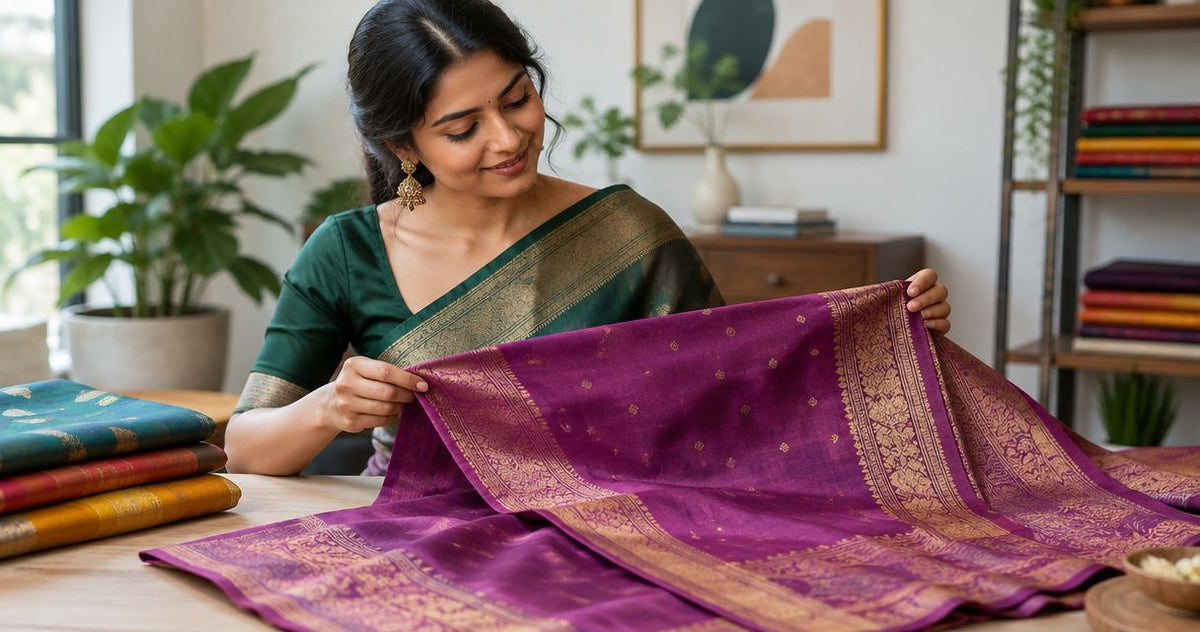
Plan your saree fabric by marking the lower border, pleat area and shoulder pallu on a flat layout before deciding how much to buy. Confirm the usable width, embroidery direction and whether the pallu is included in the design; a decorative border alone does not establish any of these details.
- Choose saree fabric around border placement, comfortable pleats and the pallu you want to show.
- Doeraa sells embroidered fabrics for retail shoppers and boutiques; check each design against your saree layout.
- A fabric with a border does not automatically include a separate pallu design.
- Approve usable width, continuous length and motif direction with your tailor before ordering.
How do you plan borders and pallu when buying saree fabric?
Start with the finished drape, then work backwards to the fabric layout. Sketch where the lower edge will sit, which section will form the front pleats and which end will pass over your shoulder. Keep the blouse separate from this calculation unless your tailor has explicitly included it.
When browsing Doeraa, compare the position of the embroidery as carefully as its colour. A floral motif that looks beautiful in a close-up still needs to sit correctly when the cloth is folded, pleated and draped.
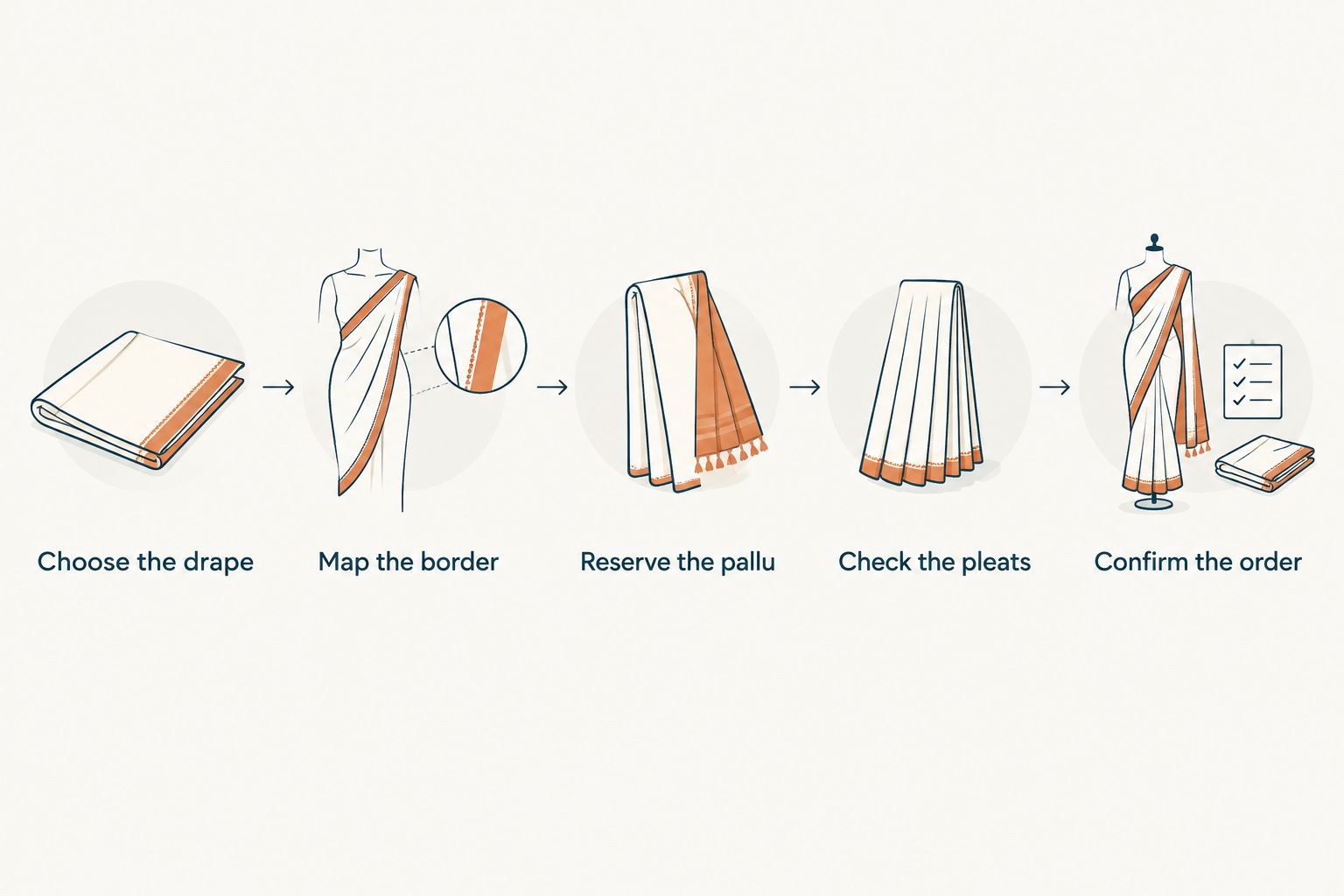
Follow this sequence for your 2026 saree project:
- Choose the drape. Decide how you intend to wear the saree and whether the pallu will hang open or sit in shoulder pleats.
- Map the border. Establish which long edge carries the design and where you want it visible.
- Reserve the pallu. Mark the section that will fall from the shoulder, including its intended decorative face.
- Check the pleats. Ask your tailor to fold the proposed pleat section and assess overlapping embroidery.
- Confirm the order. Approve the continuous length, usable width, finishing and separate blouse requirement before purchase.
Why this matters
A saree reveals fabric differently from a stitched kurta or blouse. Some areas lie open, others disappear into folds, and the pallu draws attention around your shoulder and back. Buying only from a close-up leaves those relationships unresolved.
For a 2026 occasion outfit, settle the placement before choosing matching blouse fabric or accessories. This keeps the main decision practical: does the embroidery support the drape you actually want to wear?
Which border and pallu plan suits your saree?
Choose a layout rather than assuming every embroidered length works the same way. The comparison below describes design approaches, not guarantees about any individual fabric.
| Layout | Best for | Main advantage | Main limitation |
|---|---|---|---|
| Existing border with a matching-body pallu | Shoppers who want visual continuity | The body and pallu share the same design language | The pallu has no distinct end panel unless one is specified |
| Existing border with an added pallu panel | Shoppers who want a separate focal point | You can plan a different decorative end | The join, colour and fabric behaviour need checking |
| Separate border on a plain or embroidered body | Shoppers who want control over edge placement | You can position the border around the chosen layout | Attachment and corner finishing become part of the work |
| All-over embroidery without a distinct border | Shoppers who prefer an uninterrupted surface | The motif continues across body and pallu | Folding can hide motifs or concentrate embellishment |
Choose an existing border for continuity, not as proof of a complete saree layout. For any approach, ask to see the whole fabric width and enough length to understand the repeat.
Existing border with a matching-body pallu
This approach uses the same fabric design through the body and shoulder end. It suits you when the fabric itself should remain the focus, without a contrasting panel.
Check both long edges rather than assuming they match. Ask whether the border runs continuously and whether the pallu end requires separate finishing. A lengthwise border is not the same feature as a decorative crosswise end.
Existing border with an added pallu panel
A separate pallu panel gives you a deliberate change at the shoulder end. Before committing, ask your tailor to place the proposed fabrics together, with the join visible and then folded into the intended drape.
Judge the reverse as well as the front. An open pallu can expose its underside, so thread ends, joins and finishing belong in the design conversation, not just the stitching stage.
Separate border on the saree body
An attached border lets you decide where the edge decoration belongs. The trade-off is extra construction: your tailor must assess how the border follows the body fabric without pulling or distorting it.
Check the intended hem treatment before attachment. Do not let the decorative edge become the only reference for cutting if the base fabric needs straightening first.
How do you judge border width and placement?
Judge a border at wearing scale, not photograph scale. Hold or position the cloth at the intended lower edge and look at the relationship between the border, body motifs and your chosen blouse.
There is no single border measurement that resolves every design. Your height, preferred drape and the actual fabric layout belong in the decision; ask your tailor to mark the finished position rather than choosing from a generic rule.
Check these points together:
- Lower edge: establish where the visible border ends after finishing.
- Upper edge: identify any decoration that will be tucked or folded away.
- Motif direction: check whether flowers, leaves or figures have an obvious upright position.
- Border continuity: inspect whether the pattern continues through the required length.
- Corners and ends: decide how the border meets the pallu finish or any added panel.
For your 2026 shortlist, save a full-width photograph alongside each close-up. The close-up helps you examine stitch detail; the wider view helps you understand placement. Neither establishes the fabric's feel in your hand.
How should you plan a pallu that falls neatly?
Start by deciding whether you want an open pallu or a folded shoulder pallu. Then assess the decorative section in that exact arrangement rather than judging it only as a flat rectangle.
For an open pallu, inspect the full motif arrangement and the reverse. For a folded pallu, check which part of the design remains visible on the outer fold. Do not approve placement while the most important motif is hidden inside the folds.
Place the intended pallu over the actual blouse fabric, or a confirmed fabric reference, before finalising the combination. This is especially useful when comparing similar shades: a product photograph is a reference, not a promise of an exact on-screen colour match.
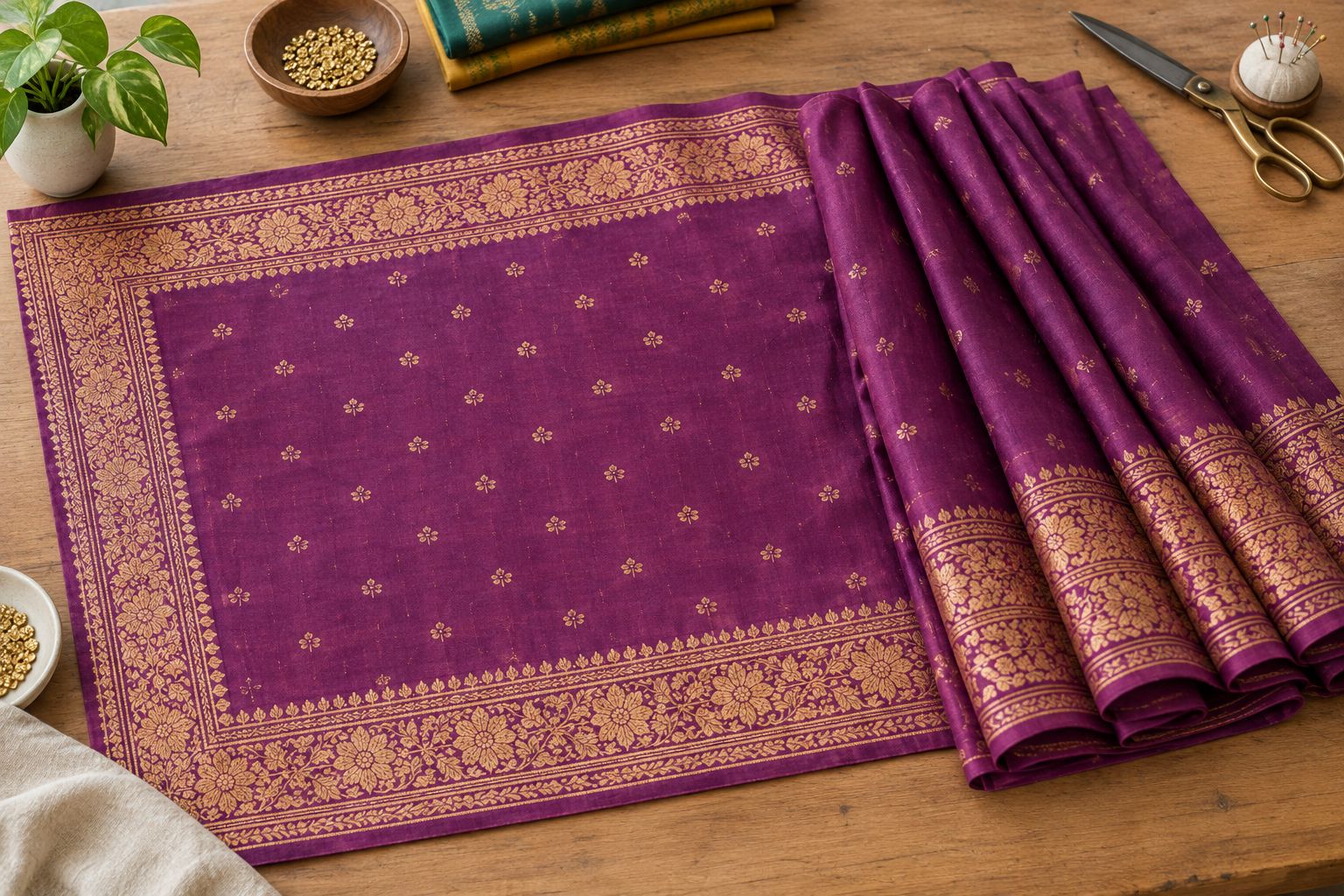
Keep any extra decorative treatment separate in the plan. An added border or panel needs its own placement decision; it should not be treated as an automatic extension of the body fabric.
Why border and pallu planning varies
The right layout changes with the actual fabric, not just the colour or occasion. Use these factors to narrow your choice:
- Usable width: the finished layout depends on the cloth you can use after allowing for edges and finishing.
- Embroidery position: a border, scattered motif and positional design give you different placement choices.
- Embellishment distribution: overlapping decorated areas need checking in the pleats and at the shoulder.
- Base fabric: net, georgette and tissue require individual assessment for transparency, feel and drape.
- Cut-piece length: a fixed cut must accommodate the approved plan; its label alone does not establish suitability.
- Finishing method: hems, attached borders and joined panels need to be accounted for before cutting.
Doeraa's embroidered fabric range is best for shoppers who want to choose the decorative cloth before finalising their outfit layout. The benefit is design choice; the responsibility is checking whether the individual piece fits your saree plan.
How much saree fabric should you order?
Order the length your tailor confirms for the complete layout, not a quantity inferred from a product photograph. Ask for the body, pleats, pallu and finishing requirements to be considered together, with the blouse recorded separately.
The listed cut pieces illustrate why this check matters. A 0.75 metre black soft-net piece, a 2 metre bottle-green soft-net piece and a 5.25 metre navy-blue soft-net piece describe different fixed lengths; none of those labels independently confirms a complete saree, pallu or blouse allocation.
For a 2026 order, confirm that the required length is continuous. Separate pieces with the same design name do not establish an uninterrupted layout, and a join needs deliberate approval rather than discovery during cutting.
Ask your tailor to record:
- The intended finished saree layout and wearing style.
- The usable fabric width needed for that layout.
- The continuous body-and-pallu length to request.
- Any separate border, panel or blouse fabric.
- The finishing allowance appropriate to the actual cloth.
What should you check on a fabric listed with a border?
A product title that explicitly names a border gives you a useful starting point. Still request a full-width view and clarify the border's location, continuity and relationship to the body embroidery.
For example, Doeraa lists the mint-green leafy and gajri-pink floral soft-net fabrics below with borders. Best for: shoppers comparing thread-and-zari designs with an existing decorative edge. Their limitation is equally important: the title does not establish a separate pallu panel or an approved saree quantity.


Before selecting either design, apply the same checks to the actual cloth: transparency against your intended underlayers, comfort where decoration touches the body, and the appearance of folded sections. Do not substitute the fabric name for those checks.
What should boutiques include in a bulk enquiry?
For boutiques planning several sarees, turn the approved layout into a written brief. State whether every garment needs the same border position, motif orientation and pallu treatment, rather than requesting only a total quantity.
When enquiring with Doeraa about wholesale fabric, specify the required continuous length for each saree and identify any separate blouse or pallu material. Ask how the proposed pieces relate to your layout before approving the order.
For a 2026 boutique order, keep the approved reference photographs and placement sketch together. That gives the person buying the fabric and the person cutting it the same design reference.
FAQ
Does saree fabric with a border already have a pallu?
No, a border does not establish that saree fabric includes a distinct pallu panel. Confirm whether the design has a decorative end section or whether the body fabric will continue through the pallu.
Should I choose the border or the saree body first?
Choose the overall drape first, then assess the body and border together. Confirm that their placement works before finalising the quantity.
Can I make a pallu from a separate piece of fabric?
Yes, a separate piece can form an added pallu panel if your tailor approves the construction. Check the join, reverse, colour relationship and drape before cutting.
How do I stop embroidery disappearing inside saree pleats?
Mark the important motifs and test-fold the intended pleat section before cutting. Adjust placement so the details you want to show remain on visible folds.
Is a 5.25 metre cut piece enough for my saree?
A 5.25 metre cut piece is enough only when your tailor confirms that your complete layout fits that continuous length and its usable width. Check the pallu, finishing and separate blouse requirement before ordering.
Can I choose saree fabric colour from photographs alone?
Photographs help you shortlist saree fabric colours but do not guarantee an exact match to your screen or existing blouse. Ask how you can assess the intended combination before stitching.
What should I ask before buying embroidered saree fabric online?
Ask about usable width, continuous length, border position, motif direction and the pallu design. Also clarify care and finishing requirements for the specific fabric.
One last thing
Make one uninterrupted viewing pass from the lower border to the shoulder end before approving the cut. A motif can look correctly placed in each separate photograph yet disappear when the whole saree is arranged for wearing. Keep the folds in place while you make the final decision.


Leave a comment
This site is protected by hCaptcha and the hCaptcha Privacy Policy and Terms of Service apply.