
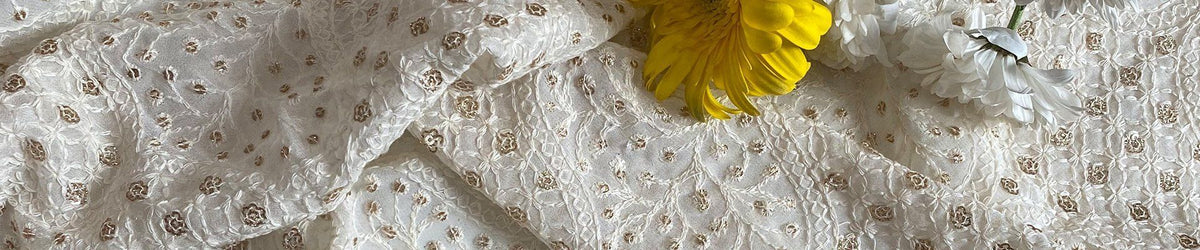
Choose saree fabric for comfortable pleats by checking how the actual material folds, how decoration sits across those folds and how the finished drape feels at the waist. Compare the pleated section and pallu separately; a beautiful open surface is not the same as an easy-to-wear drape.
- Choose saree fabric by folded behaviour, not an open photograph alone.
- Keep pleat placement and pallu design in the same cutting plan.
- Doeraa suits shoppers comparing fabrics for a personally planned saree.
- Confirm usable width, borders and care before ordering an unstitched cut.
Why the pleats deserve their own check
Pleats gather part of the saree into a smaller area while the pallu displays another part more openly. Decoration, borders and fabric handling affect those areas differently. Choose with both in mind.
Start by comparing embroidery fabrics as materials for a planned garment rather than assuming every listing is a finished saree. Confirm what the product actually contains. A fabric cut does not automatically include a separate blouse piece or a prepared pallu arrangement.
For a 2026 occasion saree, write down your priorities before choosing the surface. You might care most about manageable folds, a visible border or an expressive pallu. Naming that priority makes the shortlist more practical.
How do you choose saree fabric for comfortable pleats?
Follow this order before finalising an unstitched cut:
- Choose your intended draping style.
- Inspect a folded or draped view of the actual material.
- Check embroidery in the area that will become pleats.
- Plan the border and pallu together.
- Confirm the usable dimensions and finishing requirements.
- Review comfort and care for the complete outfit.
| Surface approach | Best for | What to inspect | Limitation |
|---|---|---|---|
| Plain field | A drape where folds are prominent | How the fabric settles when folded | Texture and finishing stay visible |
| Spaced motifs | Detail with open areas between folds | Where motifs land inside pleats | Folding can hide part of the design |
| Dense embroidery | A decoration-led saree | The pleated section as well as the open surface | Folded handling needs direct assessment |
| Border-led design | A clearly framed drape | Border direction and finished edge | Border placement must suit the intended wrap |
These are layout choices, not fabric-quality grades. No table can identify a universal best material for every drape. Assess the actual item with your wearer preferences and construction plan.
Start with the drape you intend to wear
Choose a reference that shows the waist, pleats and pallu, not only the front pose. Decide how much of the fabric will be gathered and how the pallu will be displayed. A different draping arrangement can change which areas receive the most attention.
If you work with a tailor or draping professional, share that reference before ordering. Ask which material details they need to confirm. Their answer should shape the fabric enquiry rather than coming after the cut arrives.
For your 2026 shortlist, separate your must-have requirement from optional details. An attractive motif should not distract from a fabric that does not support the drape you want. Design priorities are useful only if they guide the final choice.
Look at the fabric folded
A close-up stretched flat cannot establish how the pleats will sit. Seek a folded view that includes both decorated and less decorated areas. When handling or movement is central to your decision, a suitable sample or further evidence is more useful than guessing.
Check how the fabric behaves at the fold rather than judging only its apparent softness. The outer surface, embroidery and border all contribute to the result. A product name alone is not a complete description of that behaviour.
Do not assume that every fabric within a collection has the same thickness or composition. Read each listing separately. Clarify missing information before using a category name as a promise about pleating.
Plan what the pleats will hide
Identify the main motifs and mark where the pleated area is expected to fall. Some details will turn inward. Decide whether the visible parts still create the pattern you want.
A large motif partly hidden inside a pleat is not necessarily a defect. It becomes a problem when you bought the fabric specifically to display that motif. Your drape plan should make this trade-off deliberate.
Discuss the pattern at different scales:
- The full width of the fabric.
- The section gathered into pleats.
- The visible front once pleated.
- The pallu when displayed.
- The border at the finished hem.
This approach gives your tailor or draper concrete areas to assess. It is more useful than asking whether a material is generally good for sarees.
Check the border as a working part of the drape
Look at the border's direction and the fabric area it occupies. Confirm how it will run along the finished edge. A border that photographs well across a roll still needs to suit the wrap you intend to wear.
Ask how the edge will be finished and whether that changes the visible design. Do not assume that every fabric is supplied with finished garment edges. The listing and the construction plan should answer that question.
For a 2026 event outfit, inspect the border beside your chosen blouse material. A border can connect the two pieces visually, but it can also compete with another strong pattern. Compare the complete pairing.
Design the pallu separately, then reconnect it
The pallu is often displayed differently from the pleated section, so assess it as its own design area. Decide which part of the embroidery should remain visible there. Then check how that choice relates to the remainder of the saree.
If you are buying fabric rather than a finished saree, do not assume the cut includes a prearranged pallu. Ask your tailor how the intended arrangement can be created from the available design. Confirm any layout constraint before calculating the order.
A plain field with a decorative pallu and an evenly embroidered surface are different approaches. Both can work when planned intentionally. Choose the arrangement that supports the way you expect to wear the garment.
Compare comfort at the waist and shoulder
Think about the gathered fabric at the waist, the edge near your feet and the material resting on your shoulder. Those are different contact areas. Tell your tailor or draper where you want the garment to feel manageable.
Consider sitting and walking as well as standing. The fabric should be assessed in the drape, not just on a hanger. A photograph does not establish how a completed custom outfit will feel.
Doeraa offers fabrics for individual shoppers, boutiques and wholesale buyers. It provides designs to compare, but the specific draping and finishing decisions remain part of your garment plan. Do not treat an online image as a fitting.
Confirm width and length from the intended design
Check the actual usable width before deciding how much fabric to order. Borders, unembroidered margins and motif orientation can affect the area available for the planned drape. A measurement across the entire piece does not answer every layout question.
The sizing guide displayed on Doeraa's site distinguishes 44-inch and 56–60-inch widths. These are guide categories, not specifications for every listing. Use the information attached to your selected product.
Do not assume a generic saree-length estimate includes a blouse piece, custom pallu or additional design matching. State exactly what the order must provide. Have the tailor or draping professional confirm the cut for those components.
Review the complete care plan
Check the care information for the actual material and embroidery. If you add trims or combine fabrics, discuss the needs of the finished garment rather than the outer material alone. A similar appearance does not establish compatible care.
Ask how the saree should be stored after wearing. Use material-specific guidance rather than assuming a routine from another garment applies. Keep those instructions with your product references.
For a 2026 saree you hope to wear more than once, practical care belongs in the selection criteria. A fabric is not the right choice for you if its confirmed care needs do not fit your routine.
Is embroidered fabric harder to pleat than plain fabric?
Embroidery changes the surface, but the result depends on the actual material and layout. Compare the decorated area folded rather than declaring every embroidered fabric difficult. Dense and spaced designs present different placement decisions.
A plain surface removes motif matching from the pleat plan, but it does not guarantee comfortable handling. Base composition, fabric behaviour and the drape still matter. Assess the item, not the label alone.
Should the pallu and pleated section use the same design?
Matching the design throughout is optional. Choose a continuous surface or a distinct pallu according to the finished look you want. When buying unstitched fabric, confirm that the available layout can deliver the arrangement.
Do not buy around an imagined pallu that is not shown or described. Ask what the supplied cut includes. Clear product information is more useful than trying to solve missing design details after cutting.
Why does pleating comfort vary?
Comfort varies with connected choices:
- Draping style: where fabric is gathered and displayed.
- Material: the actual composition and handling.
- Decoration: its coverage at the folded area.
- Borders: how the edge behaves in the chosen drape.
- Finishing: the completed edge and any additions.
- Personal preference: how you want the garment to sit and move.
Keep these points in your 2026 outfit brief. They explain why a fabric that works for someone else's saree is not automatically the best match for yours.
FAQ
What saree fabric is best for comfortable pleats?
The best choice is a fabric whose actual folded behaviour suits your drape. Check the pleated section, embroidery and border together rather than choosing by material name alone.
Can I make a saree from embroidered fabric?
Embroidered fabric can be considered for a saree when its dimensions, layout and handling suit the intended drape. Confirm what the cut includes and plan finishing before ordering.
Does fabric sold by the metre include a blouse piece?
Do not assume a fabric cut includes a separate blouse piece. Check the individual listing and specify every component your order needs to provide.
Can I judge pleats from an open product photograph?
An open photograph does not establish how pleats will sit. Seek folded views or more information about the actual fabric before committing.
Should I choose the blouse before the saree fabric?
Choose the relationship between the two components before stitching. Compare colours, motif scale and shine together, whichever fabric you shortlist first.
How much fabric do I need for a custom saree?
The required cut depends on the intended drape, usable dimensions and any separate components. Ask your tailor or draping professional to confirm the layout for your design.
One last thing: photograph the fold, not just the flower
Before approving your 2026 saree fabric, ask for a view that shows the section you intend to pleat. It answers a different question from the close-up that first attracted you.
Doeraa saree-fabric choices suit shoppers planning their own drape when pleats, border and pallu are assessed together. Choose the surface you love, then confirm how it will be worn.


Leave a comment
This site is protected by hCaptcha and the hCaptcha Privacy Policy and Terms of Service apply.