
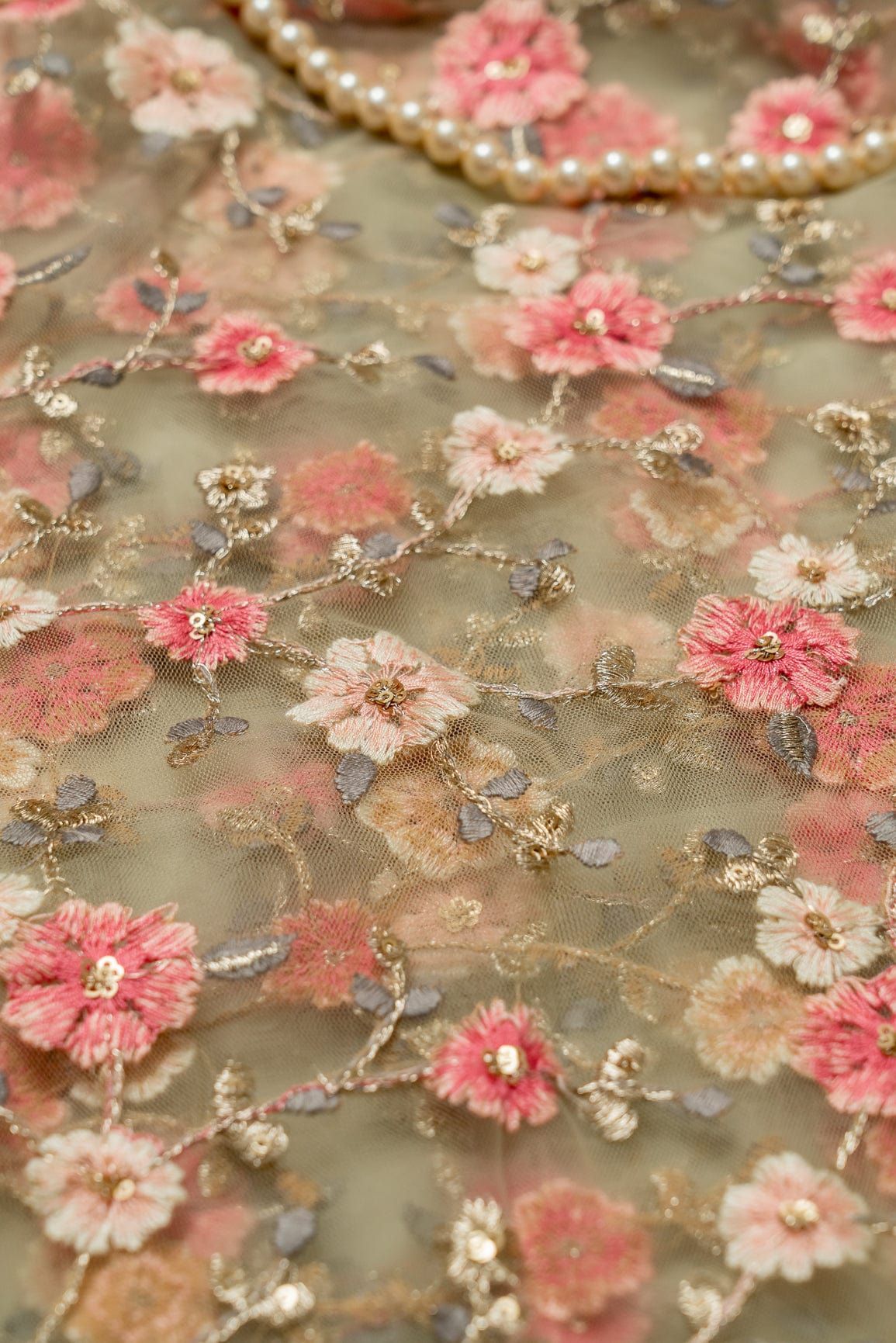
Choose net embroidery fabric for a dupatta by checking the border arrangement, motif spacing and way the fabric hangs over your outfit. Decide whether you want transparency or extra coverage before ordering; a dupatta is seen folded, draped and moving, not just stretched flat.
- Choose net embroidery fabric for the way the dupatta will be draped.
- Check border direction and motif spacing in a full-width photograph.
- Doeraa suits shoppers comparing embroidered net designs for custom dupattas.
- Confirm usable width, edge finishing and care before the fabric is cut.
Why a dupatta needs its own fabric decision
A dupatta moves between the shoulder, arm and front of an outfit. Its embroidery can look different each time you fold it. Think about the part you want visible rather than selecting only the prettiest isolated motif.
Start with net embroidery fabric and compare designs at more than one scale. Look at close-up texture, a wider repeat and any border view. A photograph cropped to a flower cannot establish how the dupatta's edges will work.
For a 2026 occasion outfit, choose the intended drape early. A broad shoulder drape, a folded front and a head covering place different areas on show. Your fabric brief should name the arrangement you expect to wear most.
How do you choose net embroidery fabric for a dupatta?
Use this sequence before your tailor calculates the cut:
- Decide the main way you will wear the dupatta.
- Identify which edges will be visible.
- Check transparency against the outfit underneath.
- Compare border detail with the central motif spacing.
- Confirm usable width and the finishing plan.
- Review care and storage with the actual material details.
| Design approach | Best for | What it contributes | Limitation |
|---|---|---|---|
| Spaced motifs | A sheer layer that leaves the outfit visible | Open areas between embroidery | Coverage depends on what sits underneath |
| Dense embroidery | A dupatta that carries strong visual detail | More decoration across the surface | Handling and comfort need checking |
| Border-led design | A drape that shows the edges clearly | A defined frame | Border orientation must match the cutting plan |
| Larger central motifs | A wider, displayed drape | A clear focal detail | Folding can hide or divide the motif |
None of these is a quality ranking. Compare the actual material and the intended use. A design with less embroidery can be the better answer when the rest of the outfit already carries substantial detail.
Choose the drape before the border
Show your tailor how you intend to wear the dupatta. Mark the shoulder, front and trailing areas on a sketch or reference photograph. This makes the visible border positions easier to discuss.
A border along a fabric edge does not automatically provide a finished arrangement on every edge of your dupatta. Check what the fabric actually includes. If additional finishing is needed, agree on it before ordering.
For your 2026 shortlist, reject a design if its strongest feature will remain hidden in your preferred drape. That is not a criticism of the fabric. It is simply a mismatch between decoration and use.
Inspect the border at the corners
Ask how the border will meet at a corner and how each finished edge will look. A product photograph of a straight border does not answer the corner question. Your tailor should explain the intended construction.
Check whether the design has an obvious direction. A trail or motif can look correct along one edge and need more planning elsewhere. Do not assume it can be rotated without changing the appearance.
Keep the border width and the central design in the same view when possible. A dramatic edge can take attention away from the centre. Decide whether that balance is right for your outfit rather than judging the edge alone.
Check transparency over the actual outfit
Place the fabric against the blouse, kurta or other garment it will cover. Net's open areas allow the colour underneath to participate in the design. A studio background is not the same as your finished outfit.
Look at both decorated and undecorated sections. A dense motif can conceal one area while the surrounding net remains sheer. Decide whether that contrast gives the appearance and coverage you want.
Ask your tailor about the intended finish if extra coverage is required. Do not add an underlayer automatically without considering movement and appearance. A dupatta designed as a sheer accessory and a lined outer layer are different projects.
Compare the motif in folded and open views
A motif that reads clearly when the fabric is open can disappear inside a fold. Arrange the shortlist in a shape close to your intended drape. Check what remains visible at the front and shoulder.
If the design is directional, identify its top and bottom before calculating length. Your tailor must know whether the motif should face outward on a particular section. That affects the cutting arrangement.
Use a simple review list:
- Which motif remains visible when folded?
- Does the border still frame the displayed area?
- Is the centre too busy beside the blouse?
- Does the colour beneath change the appearance?
- Are the edges positioned where the design needs them?
Doeraa's embroidered net designs are a starting point for this comparison. Product information and a clear layout remain necessary before deciding that an item will work as your dupatta.
Assess comfort near the neck and arms
Consider where embroidered edges will rest against your skin. Check the reverse and edge-finishing plan with the tailor, especially around the neck and arms. A decorative surface should not be judged only from the front.
Think about the time you expect to wear the dupatta and the movements involved. Sitting, greeting people and carrying a bag change the way it rests. Tell your tailor where you want it to stay in place.
For a 2026 celebration, compare the dupatta with your jewellery and blouse details as a complete styling arrangement. Look for areas where surfaces could rub. A careful drape plan is more useful than adding embellishment without considering contact.
Confirm size from use, not a generic rule
Choose the finished dimensions with your tailor according to your drape and coverage preferences. The required cut depends on usable fabric width, borders and edge treatment. There is no single length that settles every custom dupatta.
Doeraa's site sizing guide distinguishes 44-inch and 56–60-inch fabric widths. Those categories are a reminder to check the actual product, not an assurance that a selected net fabric has either measurement. Confirm the listing's width before calculating the order.
Record the difference between fabric supplied and finished dimensions. A border arrangement or edge finish can change the usable result. Ask your tailor to account for the intended construction instead of guessing from a generic chart.
Coordinate without competing with the outfit
Choose which component carries the main detail. If the blouse and skirt are strongly decorated, a more open dupatta can give them room. If the outfit is quieter, the dupatta can carry the primary motif or colour.
Compare embroidery scale as well as colour. Repeating a similar colour does not mean the motif sizes will work together. Hold the fabrics in proportions close to the finished outfit.
Look through dyed fabrics if you are planning a plain component to accompany the net. Confirm actual colour relationships before cutting. An exact match cannot be established from independent photographs alone.
Should a net dupatta have dense or spaced embroidery?
Choose spaced embroidery when you want the layer underneath to remain part of the visible design. Choose dense embroidery when the dupatta should carry more visual attention. Inspect the actual handling and reverse-side finish in either case.
The trade-off is not simply light versus heavy. Embroidery materials, coverage and base fabric all affect the result. Do not infer comfort or weight solely from the amount of shine in a photograph.
Can a border-led net fabric make a finished dupatta?
A border-led net fabric can support a dupatta design when the available borders and cutting layout match the finished arrangement. Confirm which edges are supplied and which need additional work. A single border image is not a finished construction plan.
Your tailor should check direction and corners before approving the length. If the intended arrangement cannot be achieved from the chosen cut, reconsider the layout or fabric. Resolve that before stitching begins.
Why do dupatta results vary?
The result varies with the whole design:
- Drape: which areas remain visible when worn.
- Border placement: how decorated edges frame the outfit.
- Motif spacing: how open and detailed areas alternate.
- Underneath colour: what is visible through the net.
- Finishing: how edges and corners are completed.
- Comfort needs: where the fabric touches skin or accessories.
Keep these points in your 2026 design notes. They explain why a fabric that works beautifully for one arrangement is not automatically right for another. Matching the use is more practical than chasing a universal best fabric.
FAQ
What should I check first in net embroidery fabric for a dupatta?
Check the intended drape and visible edges first. Then assess motif spacing, transparency, usable width and the border-finishing plan.
Does net embroidery fabric need lining for a dupatta?
Lining depends on the coverage and appearance you want. Discuss it with your tailor, because adding a layer changes how the fabric looks and moves.
Can I make a dupatta from fabric with one border?
A single-border fabric needs a cutting and finishing plan for the remaining edges. Confirm that plan rather than assuming the finished dupatta will have matching borders everywhere.
How much net fabric should I buy for a dupatta?
The required amount depends on finished dimensions, usable width and border layout. Ask your tailor to calculate the specific cut for your preferred drape.
Should the dupatta match my blouse exactly?
An exact match is optional. Choose a deliberate relationship between the colours and motifs, then compare the actual materials together.
Can a photograph tell me whether a net dupatta will be comfortable?
A photograph cannot establish comfort. Check the material details, reverse and edge finish, and seek clarification about the actual fabric when needed.
One last thing: check what the fold hides
Before confirming your 2026 dupatta fabric, fold the reference image into the approximate visible area. Ask whether the border and main motif still tell the same design story. This small check can change which option you prefer.
Doeraa net embroidery fabric suits shoppers choosing a decorative layer when the drape and border are planned together. Keep the finished arrangement, not the open rectangle, at the centre of the choice.


Leave a comment
This site is protected by hCaptcha and the hCaptcha Privacy Policy and Terms of Service apply.