
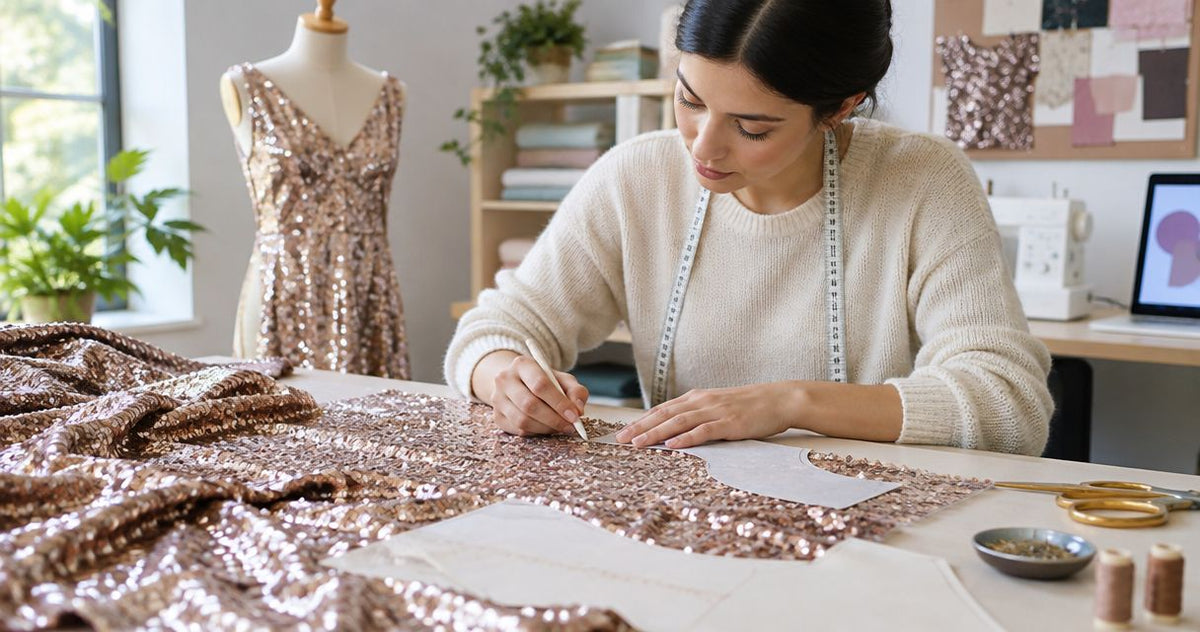
Plan seams and necklines in sequins fabric by marking the finished stitching lines on your pattern, arranging motifs around those lines, and testing the edge finish before cutting. Keep hard embellishments out of the stitching path and away from skin, and confirm the lining and neckline support with your tailor before the final layout.
- Plan sequins fabric around finished seam lines, not just the pattern’s cut edges.
- Doeraa sells embroidered fabrics for retail shoppers and boutiques; choose by base fabric and embellishment placement.
- Test neckline finishing and lining together before cutting your outfit.
- Approve motif placement, seam clearance and fabric quantity with your tailor before ordering.
How do you plan seams and necklines with sequins fabric?
Settle the fit first, map the embellishments second, and cut last. A neckline adjustment made after cutting can remove the very motif you wanted to keep. A seam placed through dense decoration also needs different preparation from a seam passing through an undecorated area.
For a blouse, kurta or evening outfit planned in 2026, give your tailor the garment sketch and fabric details together. Use this guide to plan embroidered fabric placement before cutting alongside the construction decisions below.
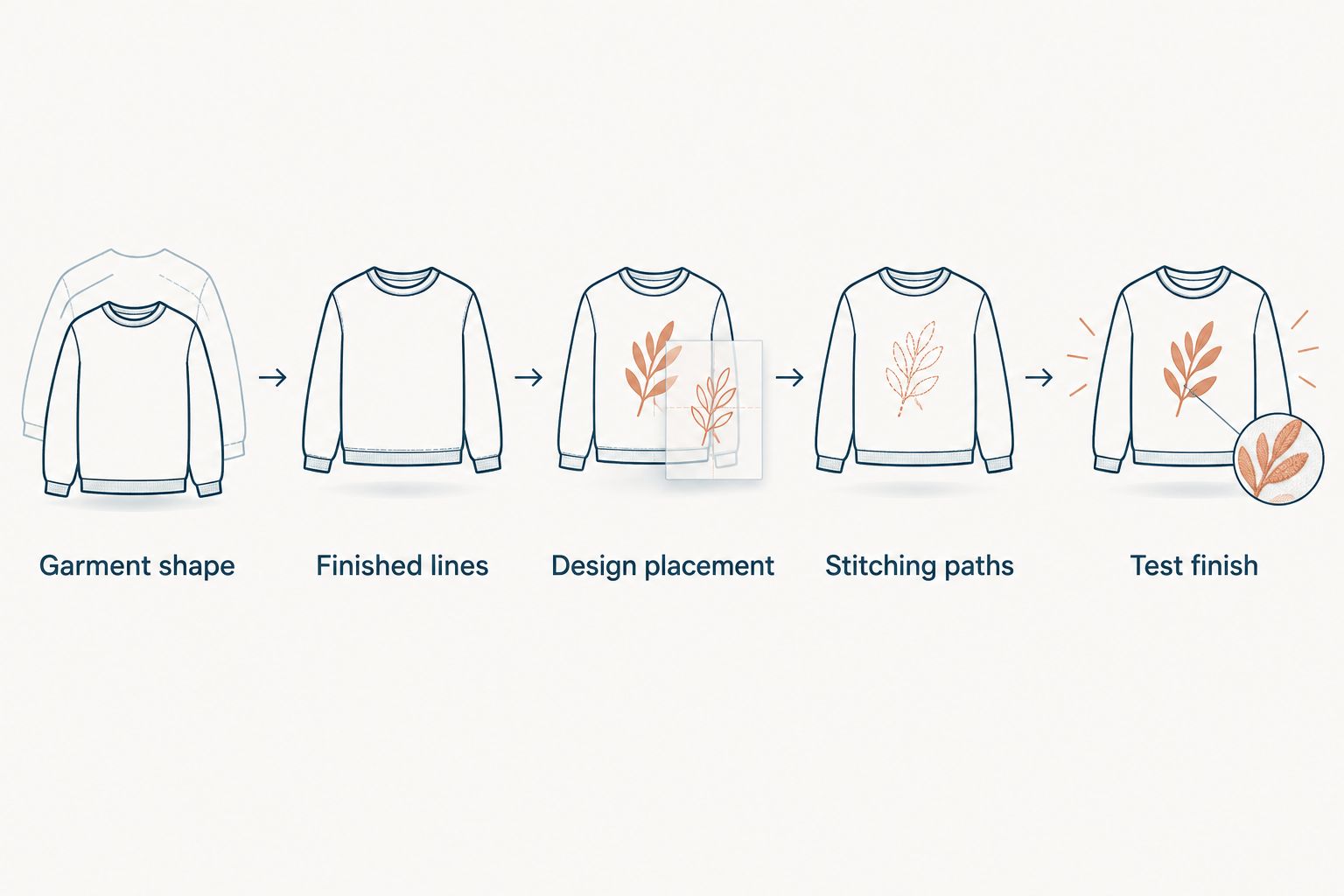
- Confirm the garment shape. Decide the neckline, sleeve, fastening and major seams before arranging motifs.
- Mark finished lines. Show the actual stitching lines, darts, folds and neckline edge on the paper pattern.
- Position the design. Place prominent motifs where you want them to appear on the finished outfit.
- Plan clear stitching paths. Identify embellishments that need careful removal without disturbing surrounding embroidery.
- Test the finish. Sew a representative offcut with the proposed lining or facing before cutting the main pieces.
Treat the approved layout as your cutting plan. Photograph it so the neckline position and motif direction remain clear when the pattern pieces move.
Why this matters
Sequins bring light and texture to an outfit, but the base fabric still determines much of its construction. Net, georgette and tissue are not interchangeable simply because each carries decorative work. Examine the complete fabric rather than choosing by sparkle alone.
At a neckline, comfort matters as much as appearance. An attractive edge still needs to sit correctly, cover the intended area and avoid exposed embellishments rubbing against your skin.
For your 2026 occasionwear order, separate the decorative decision from the fitting decision. Choose the neckline shape you can comfortably wear, then arrange the embroidery to frame it.
Choose the neckline before choosing motif placement
Start with the neckline you want on your body, not the neckline that looks easiest to cut between motifs. Bring your tailor a reference showing the front and back, and explain whether you want a close-fitting edge, an open shape or a sheer section.
A rounded neckline needs a smooth, continuous curve. A V-neck needs particular attention at its point, while a square neckline needs clean corners. These shapes do not demand identical finishing, so agree on the construction before deciding where the sequins should sit.
Ask your tailor to mark:
- The finished neckline rather than only the cutting edge.
- The centre front and centre back.
- The shoulder joins and fastening position.
- The lining coverage, including any deliberately sheer sections.
- The motifs that must remain whole and visible.
Do not deepen a neckline simply to avoid removing sequins. Adjust the decorative layout or discuss a different finish instead of sacrificing the fit you actually want.
Compare neckline finishes before committing
A lining, facing or binding addresses the edge differently. The right choice depends on the base cloth, neckline shape, decoration and intended appearance; none is automatically the correct finish for every sequinned outfit.
| Finish | Best for | Advantage | Limitation to check |
|---|---|---|---|
| Lined neckline | Outfits needing coverage behind a sheer outer fabric | Separates the decorative outer layer from the inside of the garment | Lining colour and tension can change the finished appearance |
| Facing | Necklines where you want a clean edge without visible binding | Finishes the opening while leaving much of the garment independently constructed | A facing can show through sheer fabric or turn outward if poorly controlled |
| Binding | Designs where a narrow finished edge suits the outfit | Encloses the raw neckline edge | Adds a visible line if used as an external design detail and can become bulky |
Ask to see the proposed finish on an offcut, including the actual lining or binding material. Fold and turn the sample as it will sit in the garment, rather than judging it flat on the table.
For your 2026 fitting brief, record the chosen finish beside the neckline sketch. That prevents the decorative plan and the sewing plan from becoming separate conversations.
Plan seams around the embroidery, not through its focal points
Lay the pattern pieces over the fabric before cutting and look at the design as a whole. Check what happens at the shoulders, side seams, centre back and any panel joins. A motif that looks complete on a flat length can become divided once the seam is sewn.
Mark the seam line visibly on the pattern. Decoration inside the seam allowance is not in the same position as decoration on the finished garment, and the cutting edge alone does not show that difference.
For a directional or wavy design, compare adjoining pieces in their finished orientation. Decide whether the pattern should meet across a join or whether an intentional break looks better. Do not rotate pieces merely to fit the layout without checking the resulting direction of the embroidery.
Darts deserve the same attention. Folding a dart changes the visible motif, so inspect the folded paper pattern over the design before approving it. For a closely fitted blouse, ask your tailor whether the proposed dart or panel placement preserves the decorative areas you care about.
Clear the stitching line without loosening the surrounding work
Avoid asking the needle to sew through hard sequins or beads. Prepare the stitching path first, while preserving the fabric and the embroidery that remains visible.
Inspect how the embellishments are attached before removing anything. Cutting a shared attachment thread can loosen neighbouring decoration, so remove only what the construction needs and secure loose thread ends appropriately. Do not pull embellishments out of the base cloth.
Your tailor should test the sewing setup on an offcut from the same fabric. The needle, thread and stitch settings must suit the base cloth and the prepared seam; a setting that works on plain cloth is not proof that it suits the embellished section.
Use the test seam to check:
- Whether the fabric puckers along the join.
- Whether the seam lies as intended when opened or turned.
- Whether remaining embellishments catch against the lining.
- Whether the prepared area leaves an unwanted bare strip outside the seam.
- Whether the finished join feels comfortable against the body.
Do not copy a fixed embellishment-clearance measurement from an unrelated tutorial. The actual seam allowance, sequin size and finishing method determine how much space the stitching needs.
Choose fabric with the construction in mind
Doeraa is a fabric-shopping option for retail shoppers and boutiques choosing embroidered outfit materials. Compare the named base fabric and decorative work before deciding which design suits your pattern; a product photograph cannot establish how a completed neckline will feel.
The light pink soft-net cut piece below names sequins and pink-thread wavy embroidery. Best for: considering a short embellished section after your tailor approves the layout. Its stated 0.75 metre length is a fixed cutting constraint, not a garment-quantity recommendation.
The beige and gold viscose zari tissue fabric names beads, sequins, zari and multi-thread embroidery. Best for: an outfit brief that specifically calls for these combined decorative elements. The construction trade-off is that the tailor must account for several embellishment types, not just sequins, when preparing joins and edges.


Why seam and neckline planning varies
The same neckline drawing can need a different cutting layout on a different embroidered fabric. Base your decision on the specific material and pattern, not on a general label such as partywear fabric.
- Base fabric: Inspect its transparency, movement and response to the proposed finish.
- Embellishment placement: Dense areas and open spaces create different opportunities for joins and neckline edges.
- Motif direction: Wavy, striped or directional embroidery needs an intentional orientation across adjoining pieces.
- Garment shaping: Darts, curved seams and fitted panels change which parts of the embroidery remain visible.
- Lining and finish: Coverage, edge construction and the lining’s behaviour must work together.
Product photographs help you inspect the design, but do not assume that an image proves exact colour matching, softness or seam behaviour. Confirm unclear details before committing the fabric to your outfit.
How much extra fabric should you order for motif placement?
There is no single extra quantity that suits every sequins fabric. Ask your tailor to calculate the requirement using your measurements, pattern, usable width, motif direction and the areas reserved for matching.
Fixed-length cut pieces make this especially important. The supplied catalogue includes a 4.25 metre grey organza cut piece and a 5.25 metre navy soft-net cut piece; those lengths describe different products, not standard requirements for a blouse or lehenga. Neither length tells you whether your intended pattern will fit.
Before placing a 2026 order, obtain a cutting plan that includes sleeves, shaped panels, neckline finishing and any matching requirements. Keep a suitable offcut for testing rather than assuming every part of the purchased length will become a visible garment piece.
What should boutiques specify before bulk fabric enquiries?
For a boutique’s 2026 enquiry, turn the approved sample garment into a written fabric-and-construction brief. Include the intended outfit, required fabric details, motif placement priorities and whether the same neckline treatment must work across different sizes.
Doeraa serves retail and wholesale buyers. For an enquiry, ask about the specific fabric and quantity your order requires without assuming that a retail cut piece establishes the terms for a bulk purchase.
A successful sample layout is not automatically a successful size range. Review how the neckline, darts and panel joins move between sizes before approving the fabric for repeated cutting.
FAQ
Should I remove sequins before sewing a seam?
Remove sequins that obstruct the stitching path or interfere with the planned finish. Inspect their attachment first and secure surrounding embroidery so removal does not loosen the visible design.
What is the best neckline for sequins fabric?
The best neckline is the shape that fits your outfit and can be finished comfortably on the chosen fabric. Approve its depth, support and motif placement before cutting rather than choosing by decoration alone.
Can I use a facing on sequinned net fabric?
A facing is an option only when its appearance and construction suit the net and neckline. Check a sample because the facing can remain visible through a sheer outer layer.
Does sequins fabric always need lining?
Sequins fabric does not have one universal lining requirement. Decide from the base fabric’s transparency, the garment’s coverage and the need to keep embellishments away from skin.
How much sequins fabric do I need for a blouse?
Your blouse quantity depends on measurements, sleeves, usable fabric width, shaping and motif placement. Ask your tailor for a cutting layout before choosing a fixed-length cut piece.
Can I choose Doeraa sequins fabric from photographs alone?
Use Doeraa sequins fabric photographs to shortlist designs, then confirm the construction details your outfit needs. Photographs do not establish exact on-screen colour matching or how the finished neckline will feel.
One last thing
Approve the inside of the neckline before approving the outfit. During a basted fitting, turn your head, raise your arms and check where the edge touches your neck and shoulders. A sparkling motif earns its place only when the garment is comfortable enough to wear.
Keep the neckline finish sample with your fabric and pattern. It gives your tailor a physical reference for the edge you approved, rather than leaving that decision to memory.


Leave a comment
This site is protected by hCaptcha and the hCaptcha Privacy Policy and Terms of Service apply.